The FBI warned that hackers are using the open-source AI-powered hacking tool Artex to breach networks in under three hours, affecting South Korean financial institutions (personal data of at least 68,000 people stolen), at least 2,250 ConnectWise customers' Microsoft 365 environments, and Barracuda. Artex can connect to hosted frontier LLMs from Anthropic and OpenAI as well as open-source and non-U.S. models; its July open-source release still circulates widely despite going closed-source, and researchers last week found hundreds of publicly exposed Artex systems online.

Google's Threat Intelligence Group says it has observed attackers fully automating vulnerability discovery and exploitation for the first time, with no human in the loop. An exposed server running an AI framework called "exploit_agent" connected to multiple language models compared pre- and post-patch code to identify vulnerabilities and run exploits automatically; Russian-language configuration comments and targeting of French media, entertainment, and education websites point to the operator. GTIG calls it a critical turning point but notes these attacks trade stealth for speed, leaving forensic traces that make them easier to detect.

A new GitHub repository, Eynnzerr/TelemetryCleaner, gained 1,350 stars within six days of creation. Built with Kotlin on Shizuku, it detects and lets users uninstall or restore carrier telemetry components such as SystemHelper and RegService preinstalled in China-market Android firmware, without root. The author observed SystemHelper on an OPPO device reading location, device and SIM identifiers, and installed-app lists before uploading to the cloud, and cites a WiSec 2023 paper reporting carrier components uploading installed-app lists on Xiaomi and ColorOS samples. Uninstallation works on most vendors tested, but vivo OriginOS protects com.vivo.devicereg, so a freeze-based fallback is offered instead.
Databricks launched the AI Index, which aggregates anonymized usage data from 10,000+ enterprises via Unity Gateway plus a coding agent benchmark, updating weekly. The author highlights that Gemini 3.8 Flash's low token price still averaged $11.97 per task at 140 turns, while GPT-6 Luna and Claude Opus 5.5 matched 89.1% success at $0.05 vs $1.62 per task. Single-provider setups fell from 64% to 28%, open-weight models rose to 30.9% of token traffic, and the author advises measuring cost per completed task on your own workloads rather than leaderboards.

A petition to reinstate Jensen Huang as Nvidia CEO drew over 115,000 signatures including Elon Musk and Hugging Face executives, largely from open-source AI advocates. Reporting by Will DePue suggests Chinese AI companies had more access to Nvidia Blackwell chips than estimated, while a new Commerce Department rule targets remote chip access, potentially stalling open models popular on Hugging Face.
The Trump administration is preparing to restrict foreign data centers that allow China remote access to otherwise restricted high-end AI chips, following the Nvidia scandal. The Commerce Department says the rule change closes a loophole letting rivals like China, Russia, and Iran bypass export curbs by renting access to chips in data centers in Indonesia, Malaysia, Singapore, Thailand, and Brazil, which could support military- and intelligence-related activities threatening US national security.
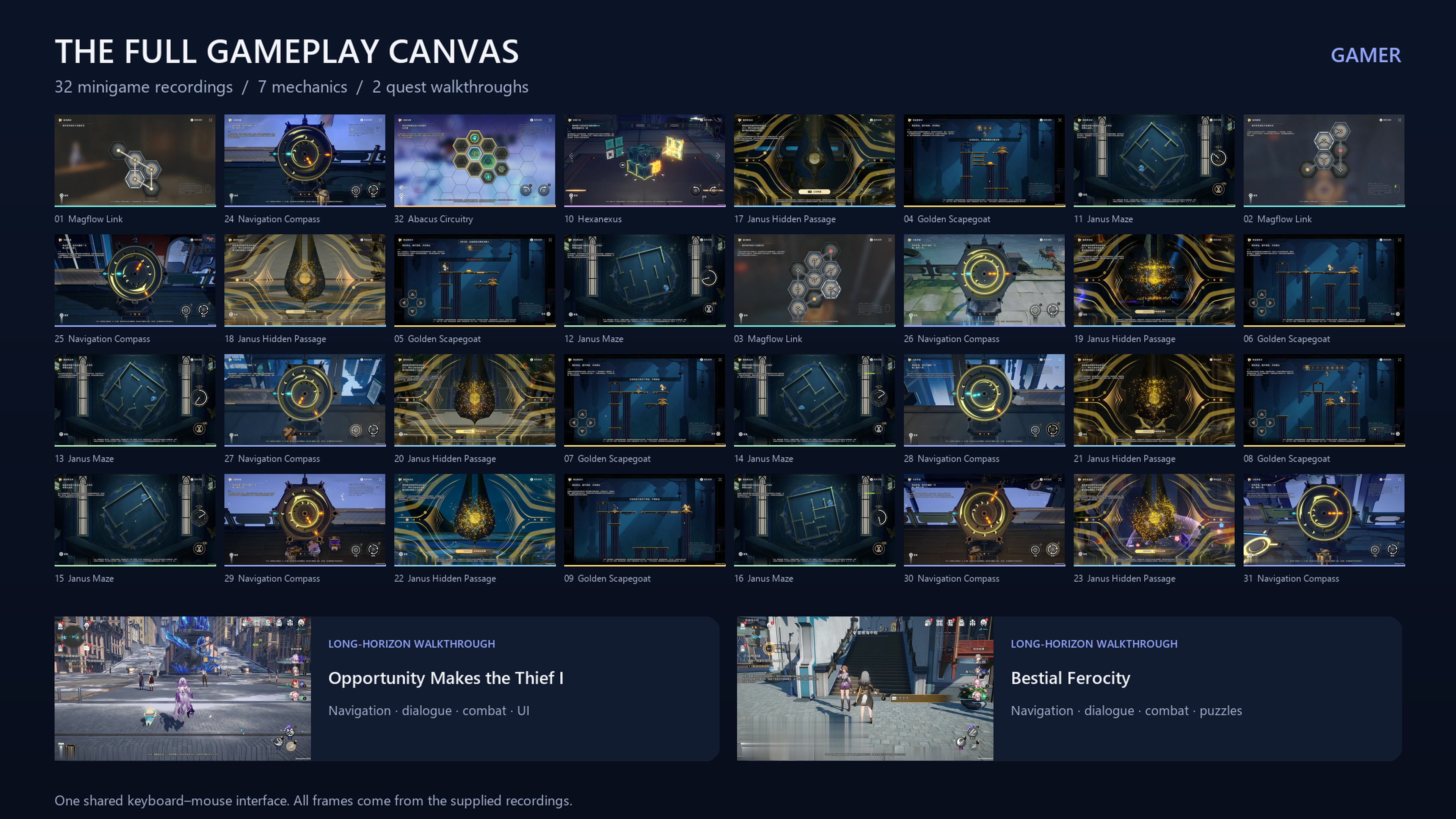
miHoYo Gamer is a generalist vision-language-action foundation model that maps 5 Hz screen observations to keyboard and mouse actions for long-horizon real-time game agents. The three-stage pipeline combines CPT for a unified control format, SFT on over 10K hours of gameplay with sparse reasoning and task-state memory, and TA-GRPO RL, reaching a 49.7% macro-average success rate across seven puzzle types and cutting end-to-end latency from 1,306 ms to 65.12 ms via Streaming-vLLM on an H200 with Qwen3.5-35B-A3B. CPT checkpoints are released, but Honkai: Star Rail data and related checkpoints are withheld for data security.
This essay argues personal agent platforms should embrace games, citing how every major consumer computing platform from Windows Solitaire to Facebook and WeChat mini games ended up with games as a daily habit and early revenue driver. It points to agents' infrequent task usage (Muse charges $20 or $100 per month), OpenAI data showing non-work ChatGPT messages grew past 70%, LinkedIn puzzle retention of 86%, and games' potential to widen audiences and business models, while weighing concerns like cost, cheating, and engagement-driven harm.