Kubernetes, the open source system that manages how applications run across thousands of AI factories, has become the foundation for AI, and the demands on it are only growing.
To help meet them, NVIDIA is deepening its commitment to open source at KubeCon + CloudNativeCon, the flagship conference for the Kubernetes and cloud-native communities.
NVIDIA is contributing NVIDIA OpenShell, an open source runtime for securing and governing autonomous agents, to the Cloud Native Computing Foundation (CNCF), a nonprofit that is part of the Linux Foundation and the host of KubeCon. As a CNCF Sandbox project, OpenShell will be governed by the organizations building it into their products and strengthened by the expertise of security professionals worldwide.
NVIDIA is also contributing to Agent Substrate, an open source Google-led framework for operating long-running agent workloads at scale on Kubernetes that has been accepted into the CNCF Sandbox.
Additionally, NVIDIA announced new components of the NVIDIA DSX AI Factory Platform: NVIDIA Kubernetes Engine, NVIDIA Kubernetes Recipes and NVIDIA Snapshot. These tools help teams deploy, manage and scale GPU infrastructure on Kubernetes for AI factories.
Together, these advancements mark a step forward in making Kubernetes the leading foundation for AI workloads at scale — empowering developers to build safer, more efficient AI infrastructure for the future.
Securing AI Agents in the Open
NVIDIA’s contribution of OpenShell to CNCF puts security infrastructure for autonomous agents in the community’s hands to build, inspect and improve — accelerating development and hardening its safeguards.
“The cloud-native community has a new infrastructure challenge: giving agents secure environments in which to operate,” said Jim Zemlin, CEO of the Linux Foundation. “NVIDIA’s contribution of OpenShell to CNCF gives developers a shared foundation to build on and an opportunity to shape how agent security evolves. Bringing this work into the community enables broader collaboration on infrastructure that will be critical to the next generation of cloud-native applications.”
OpenShell gives organizations control over what AI agents can do. It applies deterministic controls to agent activity, so teams can enforce policies as agents use tools, access inference services and execute workloads. Its extensible architecture lets teams connect their own compute, inference providers, credential storage and monitoring tools. This allows organizations to apply governance across different deployment environments while integrating OpenShell with their existing enterprise systems.
Hundreds of organizations have put OpenShell to use, and the project has received tens of thousands of contributions in less than a year since launch.
Scaling Agent Execution on Kubernetes
Governing agents is only part of the challenge. Organizations also need to deploy them at scale.
NVIDIA is contributing to Agent Substrate, a Google-originated project in the CNCF Sandbox, and ensuring it works with NVIDIA Dynamo for model inference and KAI Scheduler for shared cluster resource allocation. This effort brings together agent execution, inference serving and resource scheduling on Kubernetes.
Agent Substrate preserves agent environments between tasks while releasing compute when agents are idle. By suspending and resuming those environments across a shared pool of agents, it lets teams scale agent workloads without keeping dedicated compute running for every session.
NVIDIA and Google are also collaborating on an integration of OpenShell and Agent Substrate, so enterprises can secure and govern agents across clouds and on-premises systems.
Building an Open Foundation for AI Factories
AI factories need to offer customers managed Kubernetes services while retaining control of their infrastructure, software and customer experience. Three new open source projects extend the DSX AI Factory Platform to make Kubernetes easier to run and inference faster to scale.
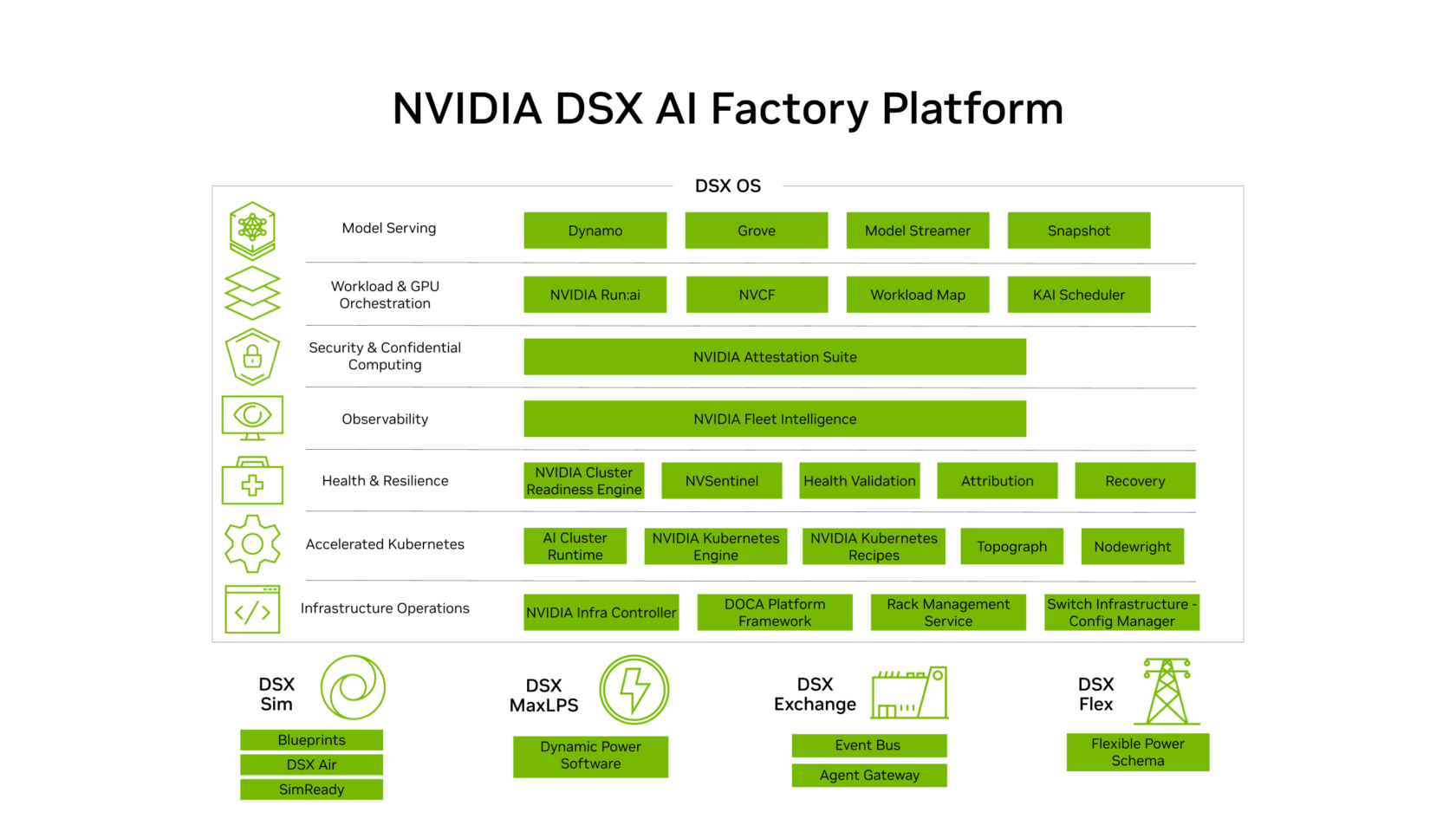
The NVIDIA DSX AI Factory Platform software stack, from GPU infrastructure and Kubernetes management to workload orchestration and model serving.
NVIDIA Kubernetes Engine (NVKE) and NVIDIA Kubernetes Recipes (NVKR) — now available in public preview — provide open source building blocks for delivering managed Kubernetes services on GPU infrastructure. They automate cluster lifecycle management and provide signed, version-pinned images.
NVKE and NVKR are launching with ecosystem support that extends their reach across AI infrastructure platforms and cloud services. Mirantis, Netris, OpenNebula Systems, Rafay, Spectro Cloud and vCluster, together with Firmus and SK Telecom, have aligned with NVIDIA on integration plans to bring NVKE and NVKR capabilities into their offerings.
NVIDIA Snapshot addresses the challenge of bringing additional inference capacity online quickly. Loading models and warming up workloads can delay scaling and recovery. The open source, modular component restores checkpointed replicas in seconds, without model reload or warmup, supporting faster startup, recovery and elasticity for inference and agentic workloads on Kubernetes.
Design partners Crusoe and Saturn Cloud have evaluated Snapshot on their own workloads using NVIDIA HGX B300 systems. Crusoe, an upstream contributor to Snapshot, tested GLM-5.3 on Crusoe Cloud and reduced the time for the workload to become ready from roughly eight minutes to 31 seconds. Saturn Cloud, a token factory platform, benchmarked Snapshot for scale-from-zero inference and reduced vLLM startup times from between two and 8.5 minutes to six and 34 seconds.
Learn more by joining NVIDIA at KubeCon.
The original belongs to NVIDIA Blog and its authors and is reproduced here for reading. To have it removed, write to support@aisa.one.

 Studio