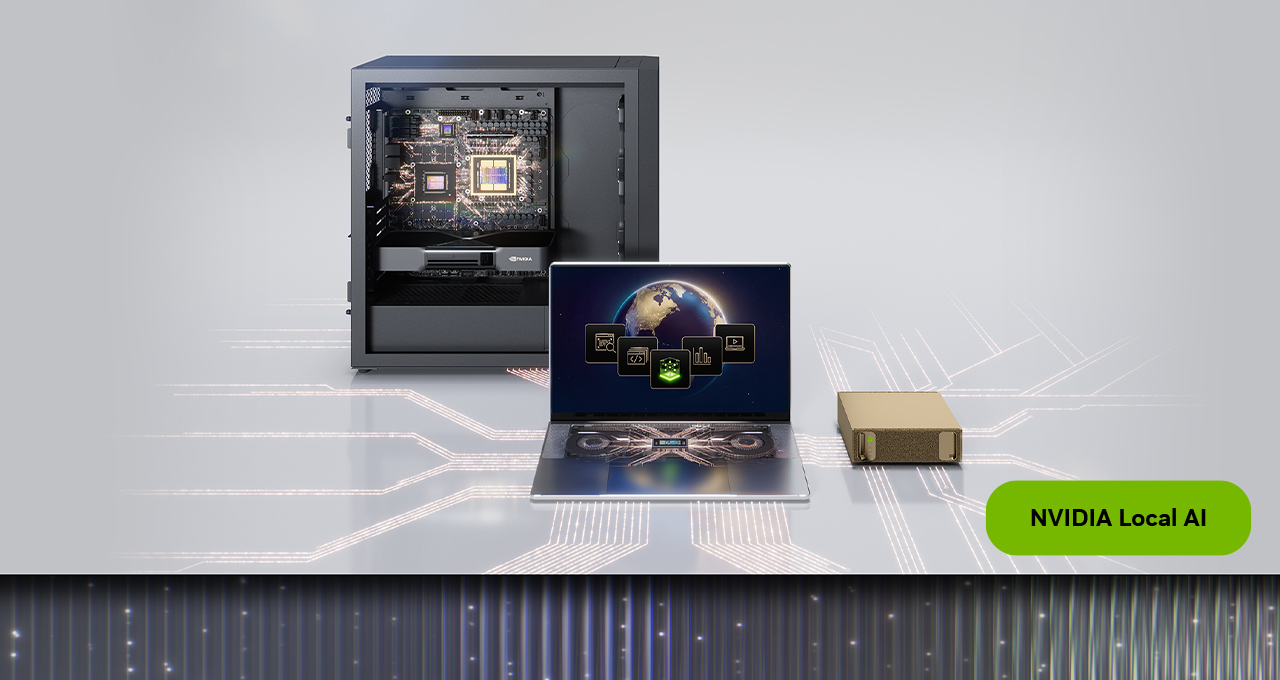
RTX Spark 是 PC 的新起点——凭借高达 128GB 的统一内存和 1 petaflop 的 AI 算力,它可运行个人智能体、加速内容创作,并实现 1440p 分辨率下每秒 100 帧的游戏体验。
Underdog 是一款专为完全本地化、私密 AI 构建的新型桌面智能体应用,也将把其体验带给 RTX Spark。依托其专用的 Husky 模型推理引擎,Underdog 完全在设备端运行模型,因此个人智能体可以在用户数据永不离开 PC 的情况下完成工作。Underdog 现已开放下载。
在 GTC 主题演讲期间,英伟达创始人兼首席执行官黄仁勋展示了如何在 RTX Spark 上运行的 AI 智能体利用 NVIDIA Isaac Lab、Hermes Agent 和 Nemotron 3.5 Bolt 74B 来训练 Hugging Face 的 Microduck 机器人。
现在,DGX Spark 支持手动配置最多八个单元组成的集群,从而支持更大的模型、更长的上下文、并发智能体和分布式开发。这对于共享单个集群作为后端的小型团队非常理想,每个开发者都可以针对同一模型运行并发会话,它提供了 1TB 的统一内存——足以运行像 GLM 5.3 这样的前沿级模型。
NVIDIA Sync Model Launcher 也将在本月晚些时候可用。它简化了在单个 DGX Spark 或集群上访问本地 AI 的过程。只需几次点击,Model Launcher 就会下载适合配置的模型和容器,并将模型连接到 OpenCode。它会自动加载 DGX Spark Skills,用于故障排除、设备维护、官方文档访问以及其他工作流指导。
10 月 DGX Spark 软件更新带来了一款新的 Wi-Fi Assistant,允许用户在 DGX Spark 以设备模式运行时切换网络。此外,DGX Spark Skills 通过 OpenCode 直接在 NVIDIA Sync 中提供针对工作流的故障排除和设备维护指导。
对于较大的团队,DGX Station 提供 748GB 的一致内存和高达 20 petaflops 的 AI 性能,使开发者能够运行像 GLM 5.3 这样的高级模型,并以与云模型相当的速度服务 30 多名用户。为了增加规模,NVIDIA Sync 现在支持 DGX Station,简化了两个基于 Linux 的系统之间的连接。
面向 Windows 的 DGX Station 将支持来自 nTop、Dassault Systèmes、Keysight Technologies、MathWorks、Rockwell Automation、Siemens、Synopsys、Unity 和 Altera 的制造类应用,用于 AI 辅助的设计、仿真、验证和工程自动化。用户可以在企业内部使用 Hermes Agent、Perplexity 或 Aible 运行智能体,以实现企业环境中的智能体控制。
开发者可以在不更改应用程序代码的情况下升级端点背后的模型,而团队成员可以直接使用共享模型而无需直接访问机器。这将 DGX Station 转变为团队本地控制的推理服务。
Recursive Flint 是使用 Recursive 的 Eureka Machine 构建的,这是一个用于大规模自动化 AI 研究的系统。它自动化了整个研究循环:提出想法、实施想法、运行实验以验证想法,并利用结果决定下一步尝试什么——创建了专用内核,在不改变模型权重的情况下,将 Flint 在 RTX Spark 上的生成速度提高了 55%。
查看原文
At GTC Berlin, NVIDIA is showcasing its full lineup of local AI hardware. RTX Spark, which launched last week, powers personal agents on Windows PCs; DGX Spark supports developers building and scaling applications on Linux; and DGX Station serves enterprise teams running frontier workloads on Linux, with a Windows version arriving in December.
Announcements include:
- Underdog Desktop Agent now available for RTX Spark
- DGX Spark 64GB available on Friday, Oct. 23
- NVIDIA Sync to support eight DGX Sparks and add Model Launcher this month
- October DGX Spark software update adds Wi-Fi Assistant and updates DGX Spark Skills
- DGX Station improves manageability with seven new integrations
- DGX Station for Windows launches in December with support for many manufacturing apps and agent harnesses
- Three new open source reference workflows for robotics on DGX Station
- NVIDIA Cloud Functions is coming in early access to DGX Station
- Recursive Flint, a new local coding model, is now available for NVIDIA local hardware
- Day-0 support for new Nemotron, GLM, DeepSeek, Qwen, MiniMax and FLUX.3 AI models
- New accelerations for llama.cpp and vLLM inference engines and a new collection of checkpoints optimized for local AI hardware.
Learn more about these local AI announcements below, and check out the demos and sessions at GTC Berlin.
RTX Spark Brings Personal Agents to the Windows PC
RTX Spark is a new beginning for the PC — running personal agents, accelerated content creation and 1440p 100 frames-per-second gaming with up to 128GB of unified memory and 1 petaflop of AI compute.
Here’s what early reviewers are saying about the platform since its October 16 release:
“A dream machine for serious creators … ” — CGMag
“Designed for the future of AI … ” — The Verge
“An extremely capable, surprisingly portable and efficient machine … ” — PCMag
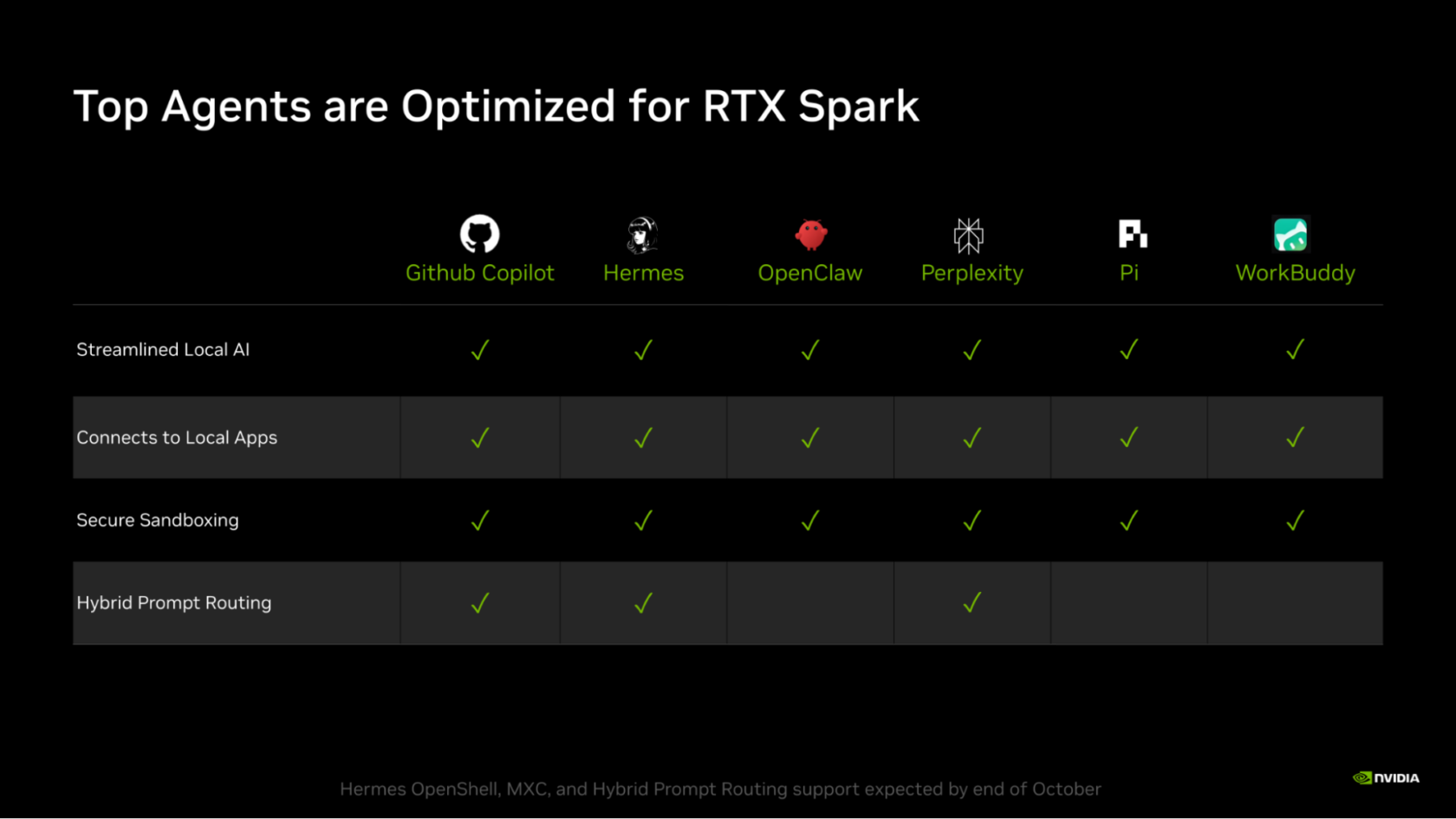
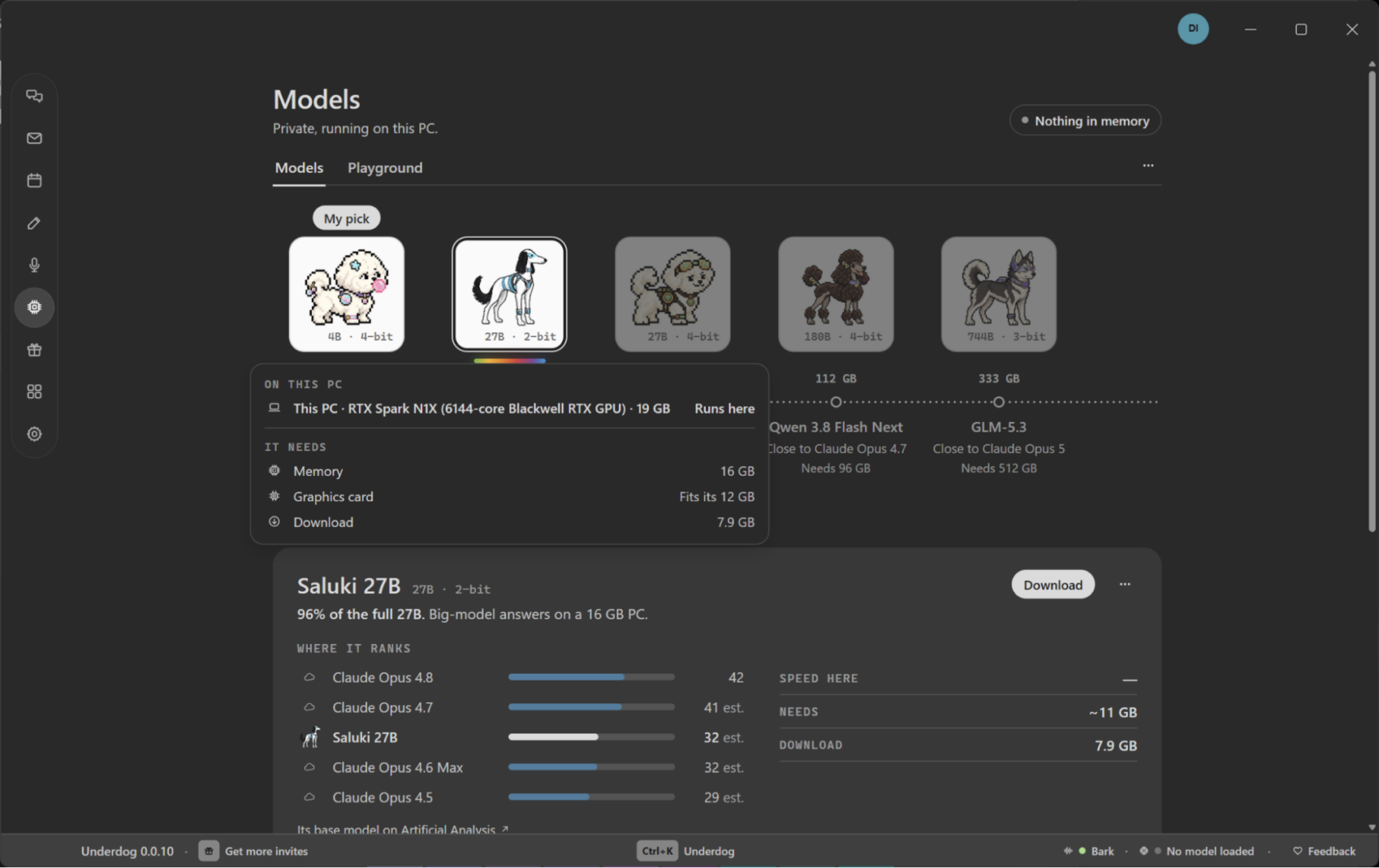
Underdog, a new desktop agent app built for fully local, private AI, is also bringing its experience to RTX Spark. Powered by its Husky model-specific inference engine, Underdog runs models entirely on device, so personal agents can get work done without user data ever leaving the PC. Underdog is available now for download.
To better enable developers and enthusiasts to build and customize local agents, many RTX Spark laptops come with an unlocked bootloader.
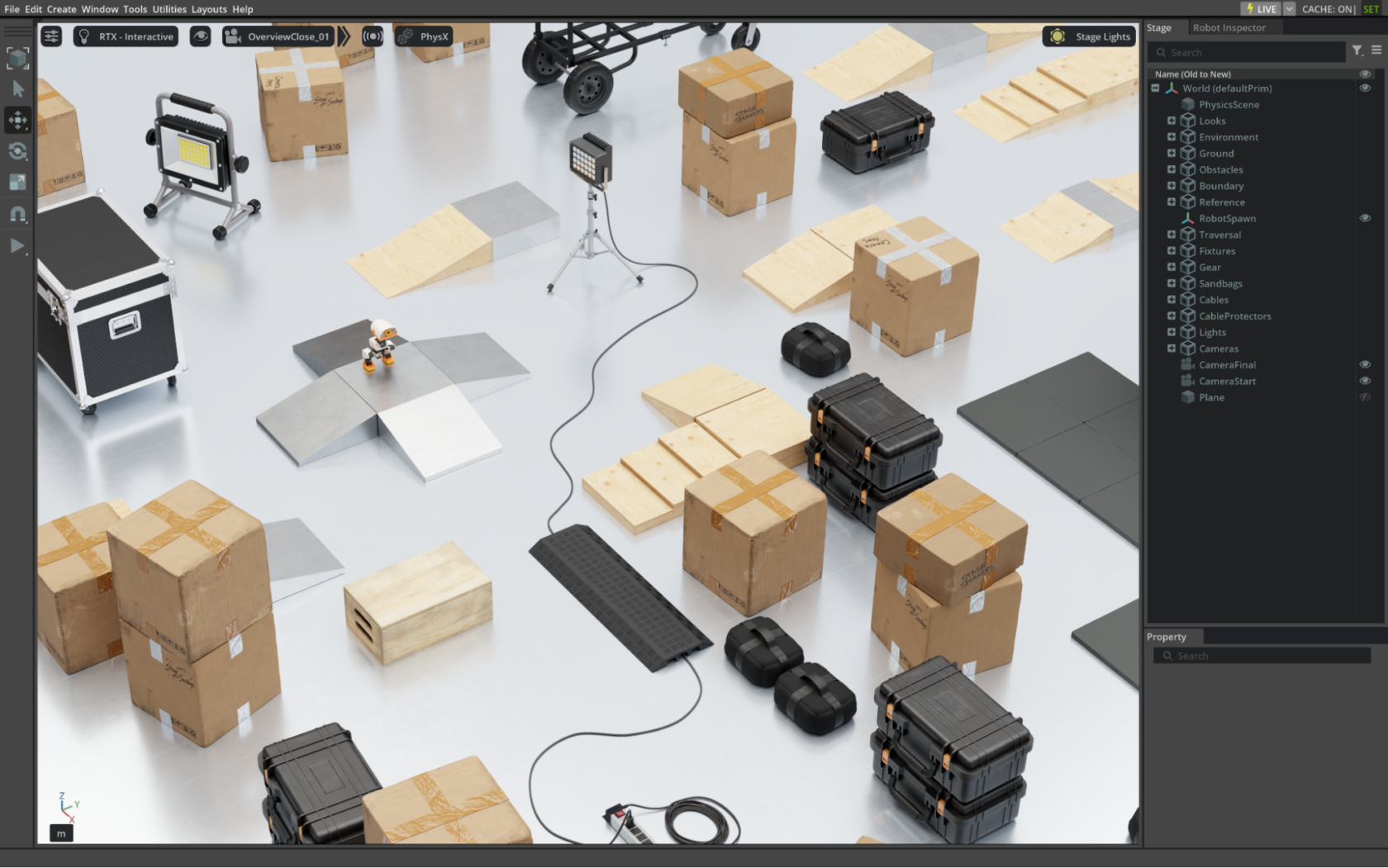
During the GTC keynote, NVIDIA founder and CEO Jensen Huang showed off how AI agents running on RTX Spark can be used to train Hugging Face’s Microduck robot using NVIDIA Isaac Lab, Hermes Agent and Nemotron 3.5 Bolt 74B.
ASUS, Dell Technologies, HP, Lenovo, Microsoft and MSI laptops are available today, with Acer coming soon.
Learn more about RTX Spark, and get started with the latest RTX Spark playbooks.
DGX Spark Gives Developers Room to Build
New DGX Spark 64GB systems — that can run models including Nemotron 3.5 Bolt 74B 24GB, Qwen3.8 27B and Gemma 4 26B-A4B — start rolling out from partners on Friday, Oct. 23.
When workloads require more capacity, developers can connect multiple DGX Spark systems via built-in NVIDIA ConnectX-7 networking and NVIDIA Sync Cluster Assistant. This allows users to run advanced coding models like Qwen 3.8 Flash Next, DeepSeek v4 Flash 0731 and GLM 5.3 Flash.
Now, DGX Spark supports clusters of up to eight units in manual configuration, enabling larger models, longer contexts, concurrent agents and distributed development. Ideal for small teams sharing a single cluster as a backend, with each developer running concurrent sessions against the same model, it delivers 1TB of unified memory — enough to run frontier-class models like GLM 5.3.
Get started with the DGX Spark cluster playbook.
NVIDIA Sync Model Launcher will also be available later this month. It simplifies access to local AI on a single DGX Spark or a cluster. With a few clicks, Model Launcher downloads a model and container suited to the configuration and connects the model to OpenCode. It automatically loads DGX Spark Skills for troubleshooting, device maintenance, access to official documentation and other workflow guidance.
The October DGX Spark software update brings a new Wi-Fi Assistant that lets users switch networks when DGX Spark is running in appliance mode. Plus, DGX Spark Skills provide workflow-focused guidance in troubleshooting and device maintenance directly into NVIDIA Sync via OpenCode.
DGX Spark systems are available directly from Acer, ASUS, Dell Technologies, GIGABYTE, HP, Lenovo, MSI and NVIDIA.
DGX Station Puts Frontier Intelligence at the Desk
For larger teams, DGX Station offers 748GB of coherent memory and up to 20 petaflops of AI performance, enabling developers to run advanced models like GLM 5.3 and serve 30+ users at speeds comparable to those provided by cloud models. Adding scale, NVIDIA Sync now supports DGX Station, simplifying connections between two Linux-based systems.
New integrations with Absolute Security, Splunk by Cisco, Fleet Device Management, Microsoft Intune, Perforce Puppet, Progress Software Chef and Tanium let IT teams manage DGX Station systems through enterprise setup, management and conformity processes, helping accelerate approvals and reduce deployment risk while minimizing time to first token.
With the upcoming Windows-based systems, developers can build workflows that harness professional applications, run on NVIDIA RTX PRO GPUs and operate from agents that run their large language models (LLMs) on NVIDIA GB300 systems — all in one machine.
DGX Station for Windows, expected from system manufacturer partners in December, extends local AI into the applications and operating environment enterprises already use. Engineers can run local models and agents in Windows-native software with access to AI models, tools and agents on the same system.
DGX Station for Windows will feature support for manufacturing applications from nTop, Dassault Systèmes, Keysight Technologies, MathWorks, Rockwell Automation, Siemens, Synopsys, Unity and Altera for AI-guided design, simulation, validation and engineering automation. Users will be able to run agents using Hermes Agent, Perplexity or Aible on premises for agentic control in enterprise environments.
The same local, controlled computing model extends to robotics. DGX Station gives robotics teams dedicated compute for post-training, simulation and evaluation, shortening iteration cycles without waiting for shared infrastructure.
NVIDIA released three open source reference workflows that bring GPT-6 Astra, NVIDIA Isaac Lab, Isaac Lab-Arena and Cosmos to NVIDIA DGX Station. Developers can use them to refine GR00T 1.7 models with reinforcement learning, train dexterous manipulation skills and post-train Cosmos world models for synthetic data generation.
NVIDIA Cloud Functions is coming in early access to Linux-based DGX Station. Teams can register local model endpoints in a shared catalog and access them through one OpenAI-compatible entry point.
Developers can upgrade the model behind an endpoint without changing application code, while teammates can use shared models without direct machine access. This turns a DGX Station into a locally controlled inference service for a team.
DGX Station brings local iteration to AI factory development. On the show floor at GTC Berlin, NVIDIA is previewing DSX OS running on DGX Station to simulate AI factory operations before full infrastructure is available. Another demo will showcase DGX Station systems powering a local token factory for more than 30 software developers.
DGX Station systems are shipping today from ASUS, Dell Technologies, GIGABYTE, HP, MSI, Supermicro and Exxact. DGX Station for Windows systems are expected to begin shipping later this year from ASUS, Dell Technologies, GIGABYTE, HP, MSI and Supermicro.
Introducing Recursive Flint — A New Local Coding Model Optimized for RTX Spark
Today, frontier AI lab Recursive Superintelligence released Recursive Flint, a local LLM built for fast, accurate coding. A 40-billion-parameter mixture-of-experts model with 2.5 billion active parameters, Recursive Flint delivers fast inference and performs well in agentic coding benchmarks like SWE-Bench Pro v2, Terminal-Bench 2.1 and SWE-bench verified.
Recursive Flint was built using Recursive’s Eureka Machine, a system for large-scale automated AI research. It automates the full research loop: proposes ideas, implements them, runs experiments to validate ideas and uses the results to decide what to try next — creating specialized kernels that boosted Flint’s generation speed on RTX Spark by 55% without changing the model’s weights.
Developers can download the open weights on Hugging Face under the Apache 2.0 license and run the model on RTX Spark and DGX Spark systems, as well as GeForce RTX and RTX PRO GPUs. Developers can also post-train the model with NeMo Automodel for supervised fine-tuning and low-rank adaptation, or LoRa, as well as NeMo RL for group relative policy optimization.
New Models With Day-Zero Support
NVIDIA is also adding day-zero model support for NVIDIA Nemotron Bolt E4B 4B, GLM, DeepSeek, Qwen, MiniMax, Liquid AI’s LFM2.5-24B-A2B, plus the FLUX.3 Klein diffusion model.
Nemotron Bolt E4B 4GB packs natural conversation and multi-turn agentic skills into as little as 4GB of memory, powering fast local voice assistants, interactive game characters and embedded interfaces on NVIDIA GeForce RTX GPUs, NVIDIA Jetson devices, and RTX and DGX Spark. Bolt E4B 4GB releases on Friday, Oct. 23.
Black Forest Labs’ FLUX 3 Image Klein is a 5.6-billion-parameter open weights image model for generation and editing. NVIDIA-optimized builds let it run on GeForce RTX GPUs with as little as 8GB of VRAM and create a 1-megapixel image in about four seconds on an RTX 5090 GPU.
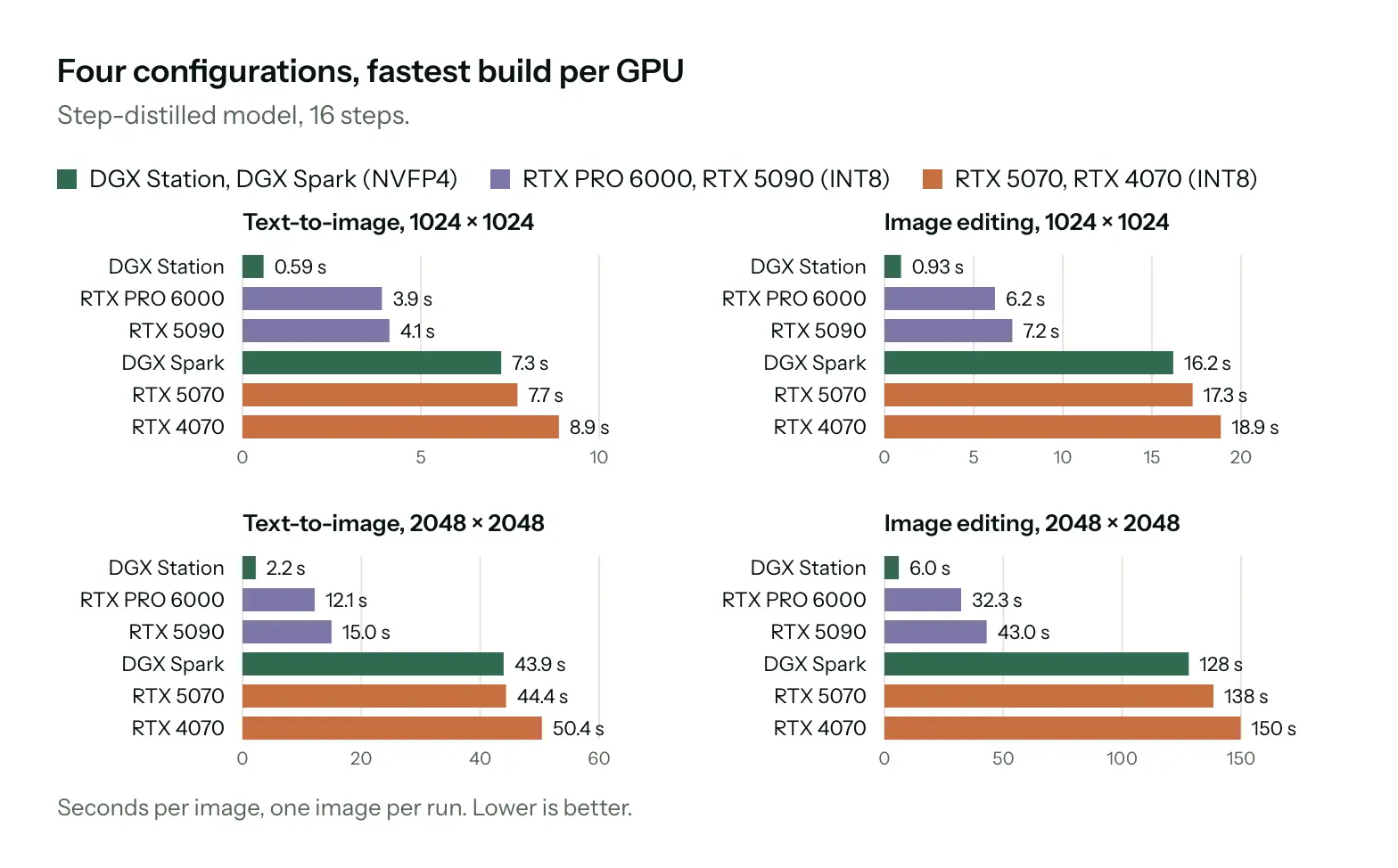 MiniMax M3.1 Flash is a new open model built for NVIDIA DGX Station and DGX Spark, bringing long-context AI to the desktop. Liquid AI’s LFM2.5-24B-A2B is an open weights reasoning model that activates just 2 billion of its 24 billion parameters per token, making it fast enough to run private, tool-calling AI agents directly on PCs.
Plus, NVIDIA has released a new collection of model checkpoints optimized for RAM efficiency on local AI hardware, enabling frontier-class open models to run with sufficient memory left over for KV cache. Each checkpoint is quantized while staying close to full-precision accuracy, starting with Qwen3.8-Flash-Next-FP4-Local on a single DGX Spark 128GB or RTX PRO 6000 and GLM-5.3-Flash-FP4-Local on two systems.
Developers can post-train on day zero with NeMo AutoModel on both DGX Spark and RTX Spark, with example recipes for Nemotron Bolt E4B, Flux 3 Image Klein and more.
Accelerated AI Inference
NVIDIA continues to work with the llama.cpp and vLLM open source communities to accelerate agentic workloads on local hardware.
In llama.cpp, new speculative decoding support with MTP for Qwen 3.8 Flash Next makes end-to-end agentic tasks up to 1.4x faster on NVIDIA RTX PRO 6000 Blackwell.
In vLLM, faster speculative decoding and new FlashInfer prefill kernels for Qwen’s linear-attention layers make agentic tasks with Qwen3.8 27B up to 1.3x faster on DGX Spark. On DGX Station, GLM 5.3 Flash gets up to 1.2x higher throughput.
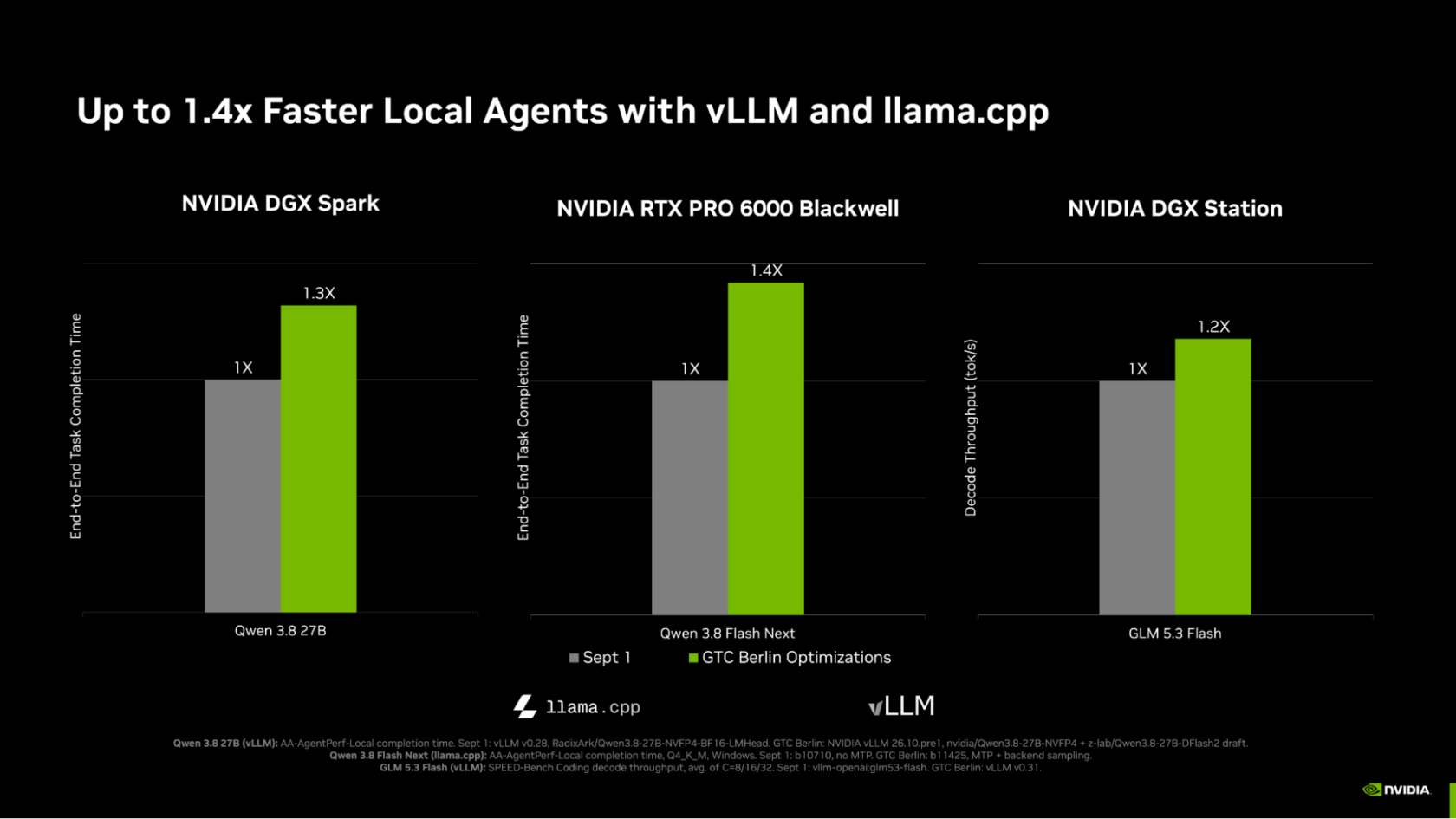
Check out NVIDIA’s local AI inference recipes to try these latest optimizations.
Follow NVIDIA RTX Spark on X, Instagram, TikTok and Facebook — and stay informed by subscribing to the NVIDIA Local AI newsletter. Follow NVIDIA Workstation on LinkedIn and X.
See notice regarding software product information.

 Studio