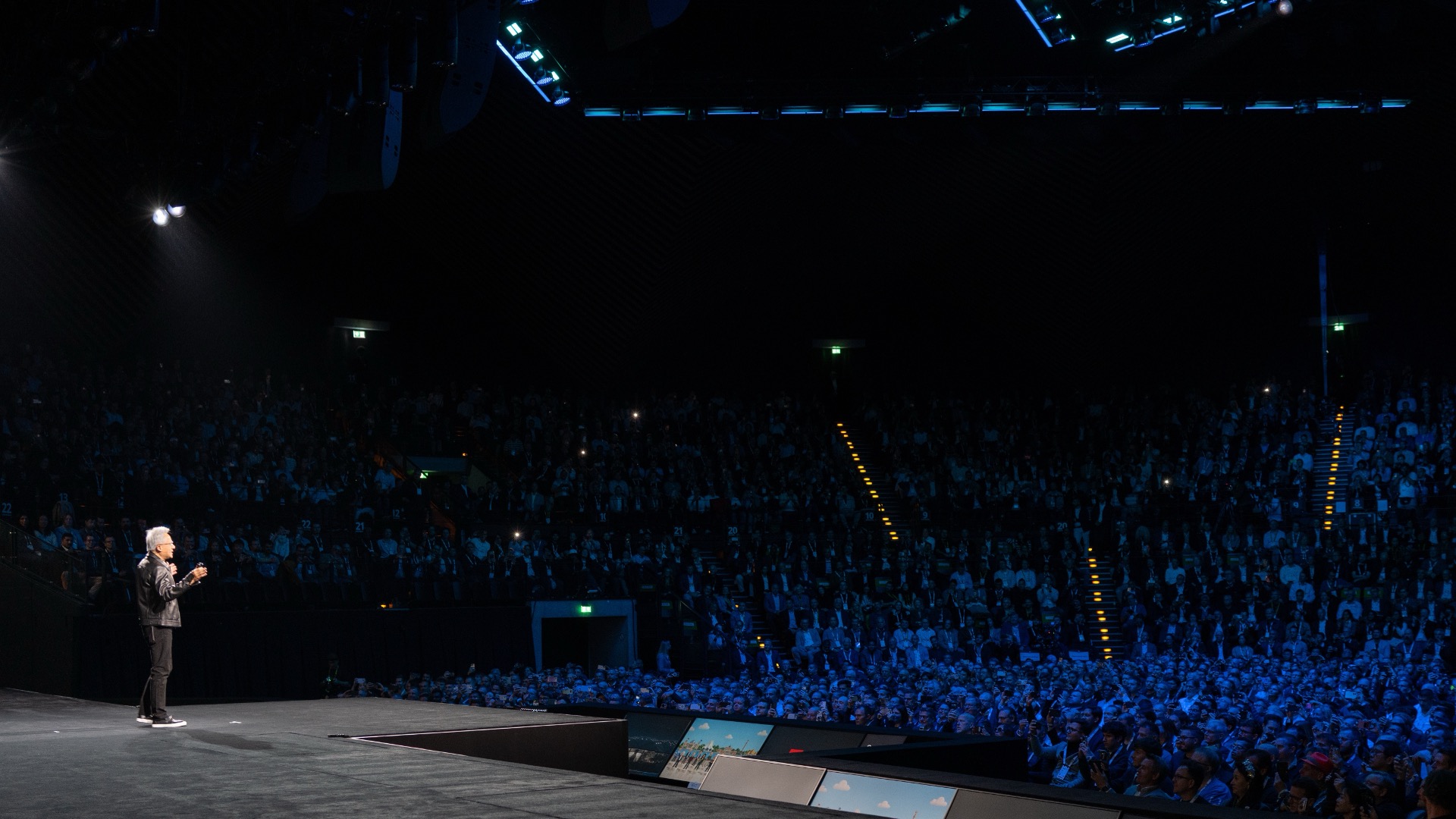
1980 年,Tempodrom 在柏林墙附近的一个帐篷里成立,此后多次搬迁,最终于 2001 年定居在安哈尔特火车站(Anhalter Bahnhof)附近。自那时起,其永久场馆一直举办音乐会、晚宴和政治活动。
GTC Berlin 为期三天,道路另一端的 STATION-Berlin 正在举行超过 100 场关于代理式 AI(agentic AI)、机器人技术、物理 AI、开放模型和加速计算的会议。在此,记者、分析师和合作伙伴聚集一堂,参加主要活动:NVIDIA 创始人兼 CEO 黄仁勋的主题演讲。
黄仁勋以一个问题开场:欧莱雅(L’Oréal)、Revolut、Spotify、默克(Merck)、沃达丰(Vodafone)、Zara、保时捷(Porsche)、雀巢(Nestlé)和高盛(HSBC)有什么共同点?他表示,它们都是欧洲公司,并且都在与 NVIDIA 合作开展 AI 项目。
“这现在代表了创建 AI 工厂所需的技术广度,”黄仁勋说。“这就是 NVIDIA 今天所构建的,这也是我们 enabling 欧洲成为 AI 生态系统和 AI 经济一部分的基础。”
他表示,全面生产的 Vera Rubin 将 NVIDIA 的计算平台从模型和大语言模型扩展到处理整个 AI 代理。他还展示了 NVIDIA 最新的机架级硬件产品。
他将代理描述为由五个要素组成:一个模型、协调其工作和记忆的 harness、隔离 harness 的沙箱,以及知识和工具。在这种框架下,代理不仅仅是一个回答问题的模型;它可以利用知识并通过工具采取行动。
NVIDIA 的前沿开放模型可在各行业使用:用于语言的 Nemotron、用于世界基础模型的 Cosmos、用于人形机器人的 GR00T、用于自动驾驶汽车的 Alpamayo、用于量子-经典计算的 Ising 以及用于物理 AI 的 Earth-2。
“你可以从一个非常优秀的开放模型开始,比如 Nemotron,然后用你自己的数据进行后训练以适应你的用例,当然,从而实现超级智能,”黄仁勋说。“这是一件非常明智的事情,而且今天所有的技术都已存在。”
Nemotron 代理协调治疗计划,Isaac for Healthcare 平台和 Omniverse 库创建了设备和患者解剖结构的数字孪生,以模拟肿瘤靶向。Holoscan with IGX Thor 将实时成像和传感器数据连接起来,以便在患者移动时实现实时自适应递送。
“肿瘤的形状在变化。你在接受治疗期间,身体也在变化,”黄仁勋说。“机器人,即这种自适应放疗系统,必须感知变化的环境,了解肿瘤的位置,完美地分割它,并相应地引导放射治疗。”
Bolt 与 Lucid、梅赛德斯-奔驰、大众商用车和 Einride 正在 NVIDIA Hyperion 计算平台上展示选定的自主移动性用例,演示 Level 3 和 Level 4 车辆以及未来无人驾驶出租车车队的潜在应用。
此外,沃尔沃汽车(Volvo Cars)正在采用 Hyperion 和 NVIDIA Alpamayo Stack 软件以实现安全的自动驾驶。NVIDIA 还引入了新的 AI 和安全技术,帮助开发人员大规模构建、验证和部署自动驾驶汽车。
查看原文
Founded in a tent near the Berlin Wall in 1980, the Tempodrom moved several times before settling near Anhalter Bahnhof in 2001. Its permanent home has since hosted concerts, galas and political events.
Today, it hosts a different kind of spectacle.
GTC Berlin runs three days, with more than 100 sessions on agentic AI, robotics, physical AI, open models and accelerated computing underway at STATION-Berlin down the road. Here, journalists, analysts and partners have gathered for the main event: NVIDIA founder and CEO Jensen Huang’s keynote.
Huang Takes the Stage
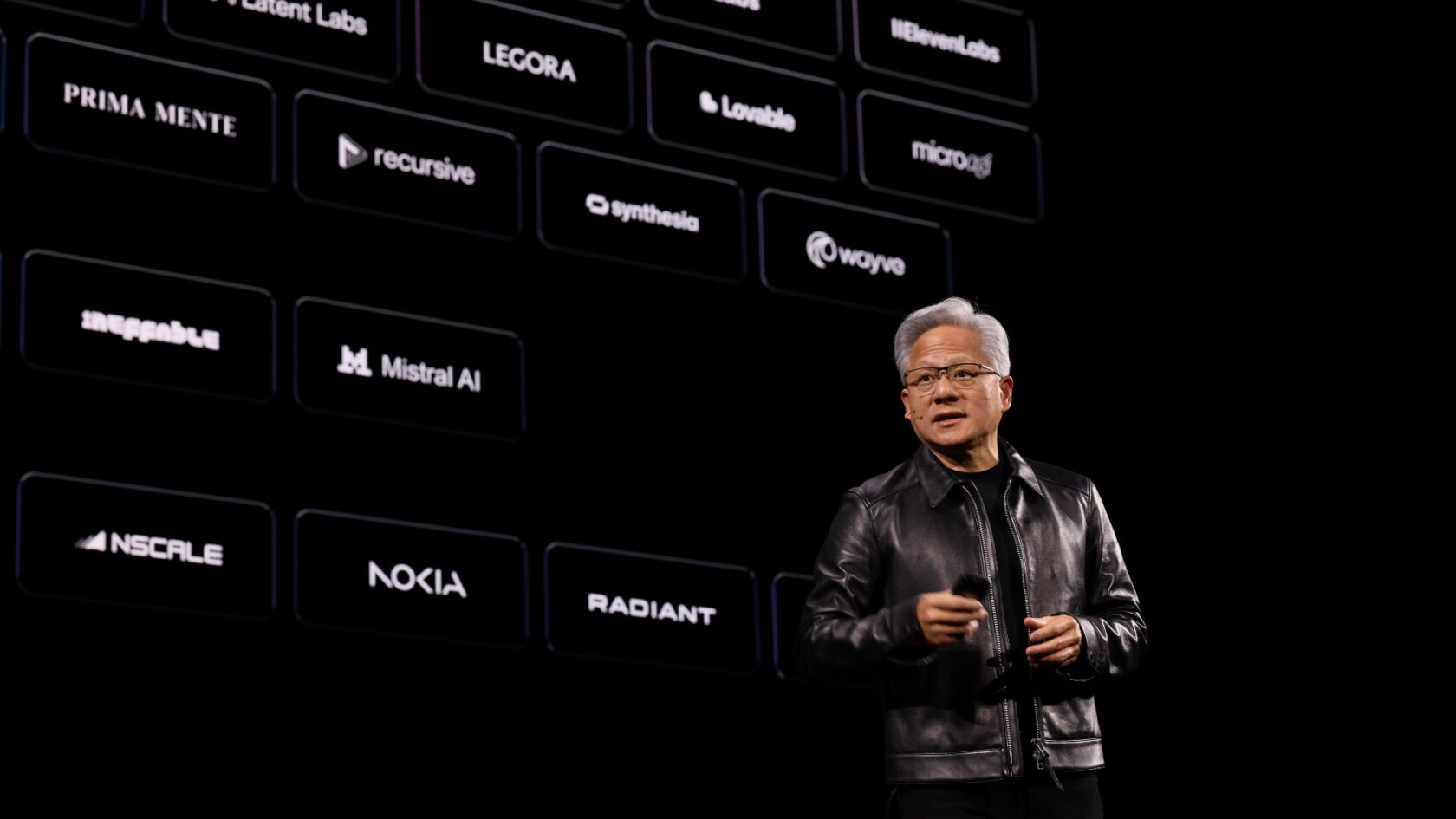
Huang opened with a question: What do L’Oréal, Revolut, Spotify, Merck, Vodafone, Zara, Porsche, Nestlé and HSBC have in common? They’re all European companies and they’re all working with NVIDIA on AI, he said.
The keynote comes on the heels of NVIDIA’s weeklong road across Europe — Paris, London, Stockholm, Dublin — with the company committing nearly $10 billion to the technology ecosystem across Europe and working with 12,000+ partners. “After decades of advancement in the computer industry, we are now at the beginnings of a new industrial revolution,” Huang said.
AI is a five-layer cake, Huang explained. Energy powers advanced computers that are part of an AI factory, which generates tokens and digital intelligence from the models that run on it, which are then integrated into every application.
“Long before the AI models emerge, the infrastructure has to exist,” he said, highlighting how, similarly, the internet first needed networking, and electricity first required the grid.
“To be part of this AI economy, you don’t want to just be consuming the AI; you want to be producing the AI,” Huang said. “We could do all of that here in Europe, and in fact, we’ve already started.”
The AI Factory Gets a New Form Factor
Huang framed NVIDIA’s full-stack AI factory — spanning hardware, system software, CUDA-X libraries and models — as a broad platform for building and operating AI infrastructure.
“This now represents the breadth of technology necessary to create the AI factory,” Huang said. “This is what NVIDIA builds today, and this is the foundation by which we can enable Europe to be part of the AI ecosystem, the AI economy.”
He said Vera Rubin, in full production, extends NVIDIA’s computing platform beyond models and large language models to process the entire AI agent. He also showed several of NVIDIA’s latest rack-scale hardware offerings.
Next, Huang announced NVIDIA DSX POD, a reference design for complete NVIDIA Vera Rubin AI factories built by partners inside modular containers, integrated and validated before delivery. With DSX POD, onsite deployment can shrink from six months to just 14 days once site utilities are ready.
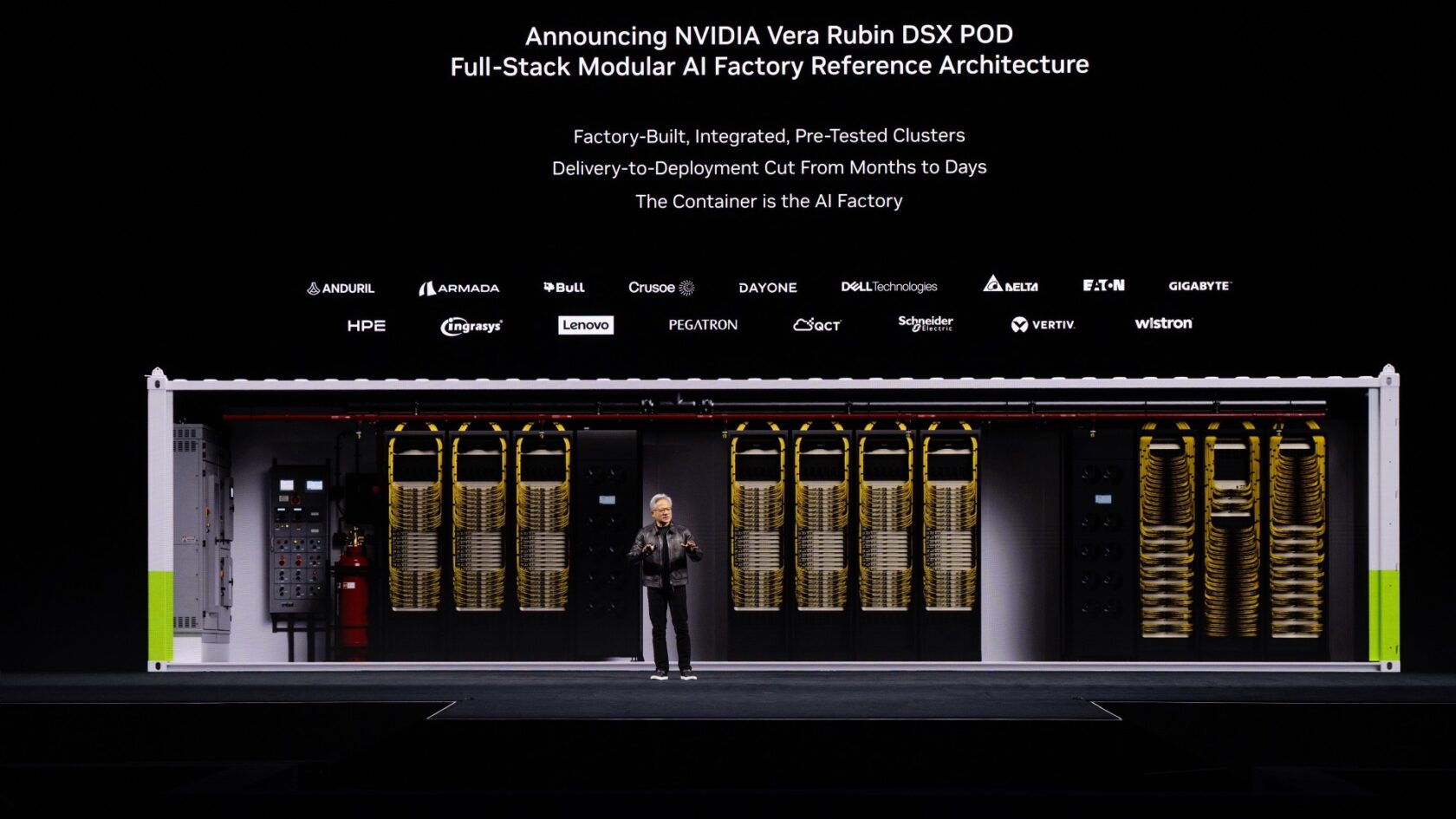
“This is a complete transformation of the world supply chain,” Huang said. “This will change the way that people install and build data centers, and hopefully, as a result, velocity goes up.”
The NVIDIA DSX AI Factory Platform enables companies to reduce water consumption for cooling by up to 100% and generate the same AI output with up to 30% less power.
Agents Are the New Computing Platform — and Safety Is an Engineering Problem
Huang said agents think, reason, iterate and use tools, driving token consumption as they become more useful.
He described an agent as comprising five elements: a model, a harness that orchestrates its work and memory, a sandbox that isolates the harness, knowledge and tools. In that framing, an agent is more than a model answering questions; it can draw on knowledge and act through tools.
“The most important thing is to make sure the agent is secure,” Huang said. The autonomous agent can access files, resources, networks and tools, so its privileges should be minimal and it should be monitored.
NVIDIA’s answer is the new NVIDIA OpenShell Reference Architecture for Safe AI Agents, a full-stack design built on NVIDIA OpenShell — an open source, policy-controlled runtime with kernel-level sandboxing that sits between an agent and the systems it can affect.
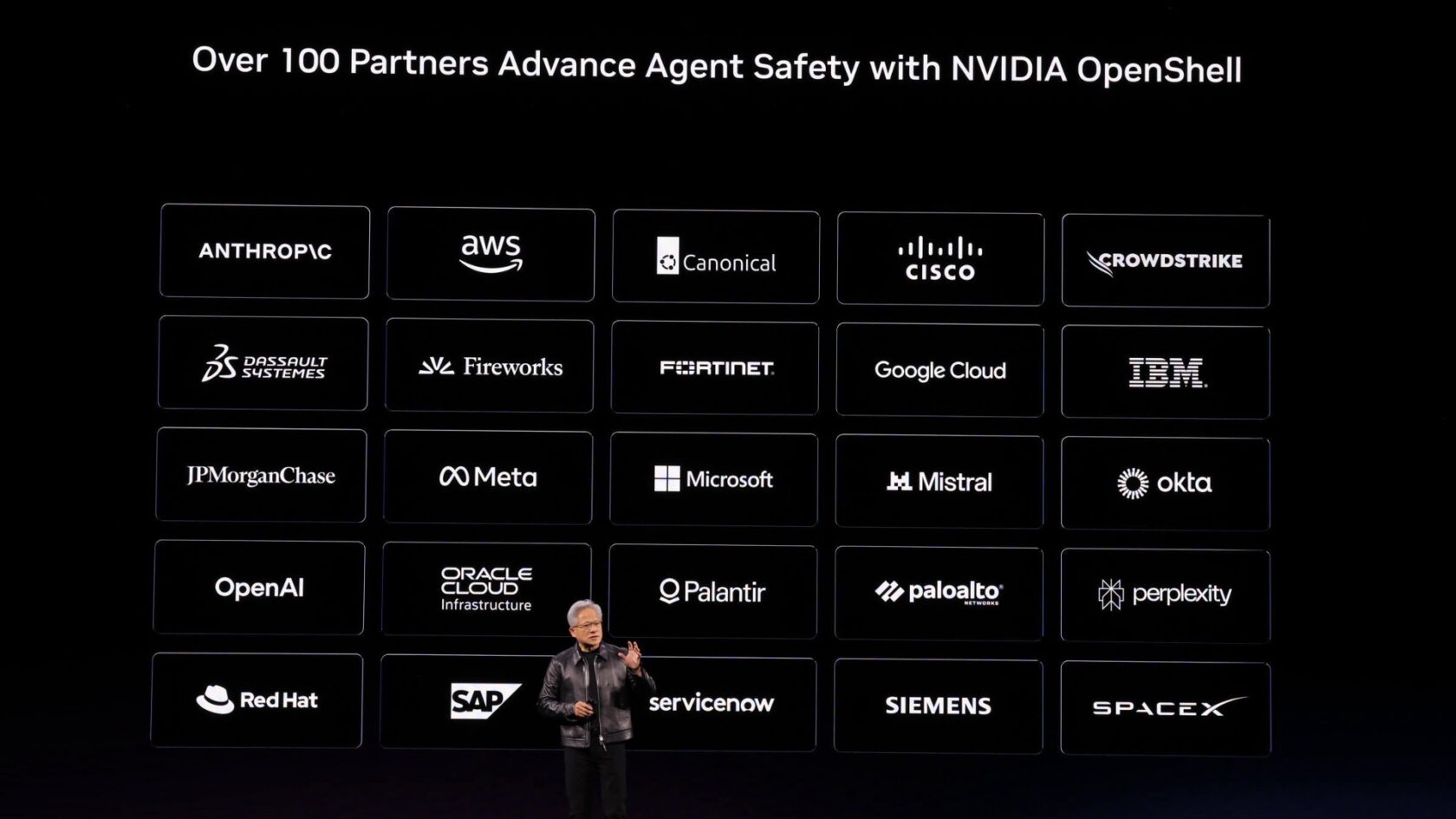
That means privileges, policy enforcement and monitoring must adapt dynamically. “Every single time an agent is launched, the privileges are different,” Huang said.
Open Models Turn Expertise Into an Advantage
Huang presented NVIDIA’s open models as a starting point for building AI tailored to specific needs.
NVIDIA’s frontier, open models are available for use across industries: Nemotron for language, Cosmos for world foundation models, GR00T for humanoid robotics, Alpamayo for autonomous vehicles, Ising for quantum-classical computing and Earth-2 for physics AI.
“We are the frontier,” Huang said. “So in all of these different areas, we offer you all of the models, and we’re continuously working on it. We’ve been working on it for a decade, and we’ll continue to work on this forever.”
NVIDIA provides the models, data and scripts to reproduce them, and companies can post-train a model on their own data for a particular use case — turning proprietary data into what he called “sovereign intelligence.”
“You could start with an open model, something that’s incredibly good like Nemotron, and with your own data, post-train it for your use case and achieve, of course, super intelligence,” Huang said. “That is a very sensible thing to do, and all the technology exists today.”
NVIDIA Gives Agents a Knowledge Layer
Huang then introduced the NVIDIA Agent Knowledge Foundation as a set of models and libraries for connecting agents to enterprise data, whether it’s unstructured information in documents or structured data in databases.
He highlighted Nemotron tools for parsing documents, embedding queries and reranking relevant information, along with new NVIDIA Kumo models for making predictions from structured data.
“Ultimately, what turns these super agents, these agents into super agents, is that you give them access to your company’s knowledge,” Huang said.
NVIDIA CUDA-X — Accelerated Tools for Agents
Huang then described NVIDIA CUDA-X as a collection of accelerated libraries used across science, engineering, research and creative work.
NVIDIA’s accelerated computing platform has more than 11 million developers building on it.
Huang said those libraries can accelerate simulators, solvers and data-processing engines — the kinds of tools agents may draw on to do useful work.
“CUDA-X tools are what gives agents the tools of the trade,” Huang said.
Agents Go to Work in Labs, Factories and Engineering
A video showcased NVIDIA Agent Toolkit bringing company knowledge, models and tools together in three industry examples:
At Lila Sciences, agents help design a potential B-cell lymphoma therapy, using virtual experiments to guide work in an automated lab.
At Siemens’ Erlangen factory, agents help prepare new products for production, testing plans in a digital twin before changes reach the factory floor.
And at Dassault Systèmes, engineering agents adapt vehicle design, using simulation to identify a problem and refine the design.
“And [all this] knowledge and tools belong to you,” Huang said after the video rolled. “That’s your expertise, and so all of this is now possible to do.”
Telcos as Distributed AI Infrastructure
Huang said AI is transforming telecommunications, improving spectrum efficiency and turning cell towers into distributed AI infrastructure.
He cited 100,000 sites and about 100 gigawatts of distributed data centers, and said NVIDIA has made its first commercial phone call on T-Mobile’s network with Nokia after nearly eight years of work.
“Now CUDA makes phone calls,” Huang said. “AI will revolutionize the way we do telecommunications. It will enhance our spectrum efficiency tremendously.”
AI Moves Into the Treatment Room
Healthcare and life sciences leaders are building on NVIDIA technologies to advance drug discovery and expand patient care.
For example, NVIDIA and Siemens Healthineers are developing AI-enabled radiation therapy.
Nemotron agents coordinate treatment planning, the Isaac for Healthcare platform and Omniverse libraries create a digital twin of the device and patient anatomy to simulate tumor targeting. Holoscan with IGX Thor connects live imaging and sensor data to enable real-time adaptive delivery as the patient moves.
Huang described adaptive radiotherapy as a physical-AI application: as the patient’s body and tumor change during treatment, the system must track the changes and adjust the radiation targeting.
“The tumor is changing in shape. The physical body is changing while you’re in therapy,” Huang said. “The robot, this radio adaptive radiotherapy system, has to perceive the changing environment, understand where the tumor is, segment it just perfectly and direct the radiotherapy accordingly.”
The Road Ahead: Mobility Leaders Join NVIDIA’s Automotive Ecosystem
Huang said the NVIDIA Hyperion computing platform is being designed into more vehicle fleets, with autonomous-driving software connecting robotaxis to ride-hailing services.
Bolt with Lucid, Mercedes-Benz, Volkswagen Commercial Vehicles and Einride are showcasing selected autonomous-mobility use cases on the NVIDIA Hyperion computing platform, demonstrating potential applications for level 3 and level 4 vehicles as well as future robotaxi fleets.
In addition, Volvo Cars is adopting Hyperion and NVIDIA Alpamayo Stack software for safe automated driving. NVIDIA also introduced new AI and safety technologies to help developers build, validate and deploy autonomous vehicles at scale.
Volkswagen’s van, JLR, Volvo and Mercedes-Benz’s next-generation vehicles will be Hyperion-compatible, Huang announced, saying, “Welcome to Hyperion.”
A Reference Humanoid for Robotics Researchers
Huang then announced Agile ONE SN, a reference humanoid built on Isaac GR00T — a 31-degree-of-freedom body, expected to be available next year, designed to cut researcher setup time from weeks to days.
The platform is modular: researchers can use the full workflow or pull in selected components.
“This is a great starting point,” Huang said.
It builds on NVIDIA’s open physical AI stack — Isaac Capture for data collection, GR00T models for robot intelligence, Isaac Lab for simulation-based training, Isaac OS for runtime — and NVIDIA’s open physical AI dataset. Partners including Agility Robotics, Figure, KUKA and NEURA Robotics are already building on the same platform.
Personal AI Gets a New Machine
Huang closed by discussing RTX Spark laptops, which launched last week, bringing together RTX graphics and NVIDIA’s full-stack AI platform in slim, premium Windows PCs for accelerated creation, immersive gaming and powerful local AI.
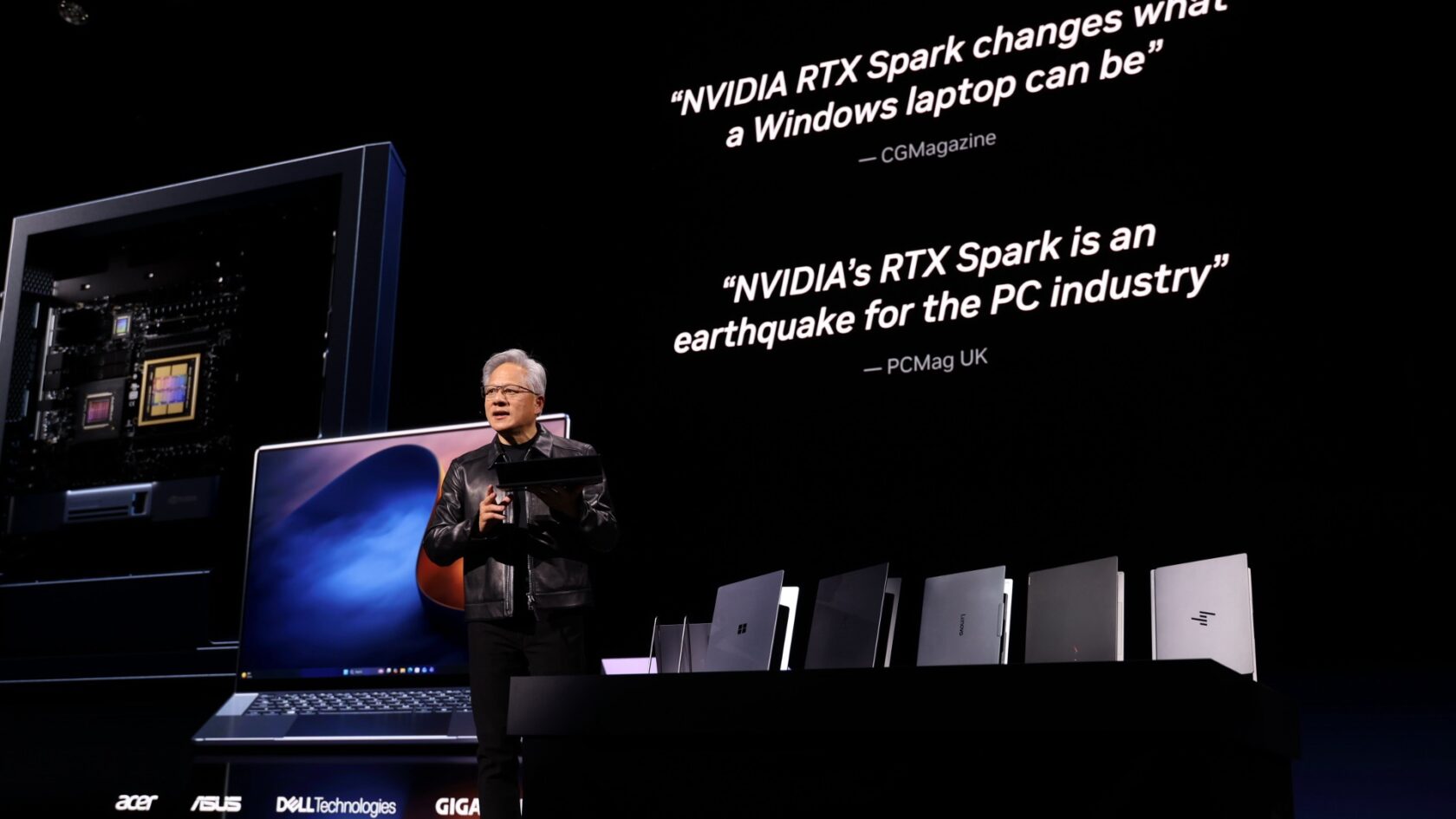
He compared its 1 petaflop of performance and 128GB of memory with the DGX-1 he delivered to OpenAI in 2016 — then made the difference in size the punchline:
“In the year 2016, I delivered 1 petaflop and 128GB … to a small company called OpenAI,” Huang said, holding up the compact machine in front of the audience. “This is 1 petaflop and 128GB. The only difference, of course, is that I can hold this like this, and DGX-1 took two people to carry upstairs.”
Huang then showed a video of an agent helping train Hugging Face’s Microduck: it set up a course and simulated the robot in Isaac Sim, sent training jobs to the cloud, then brought the learned policy back to RTX Spark for evaluation before deploying it to the physical robot.
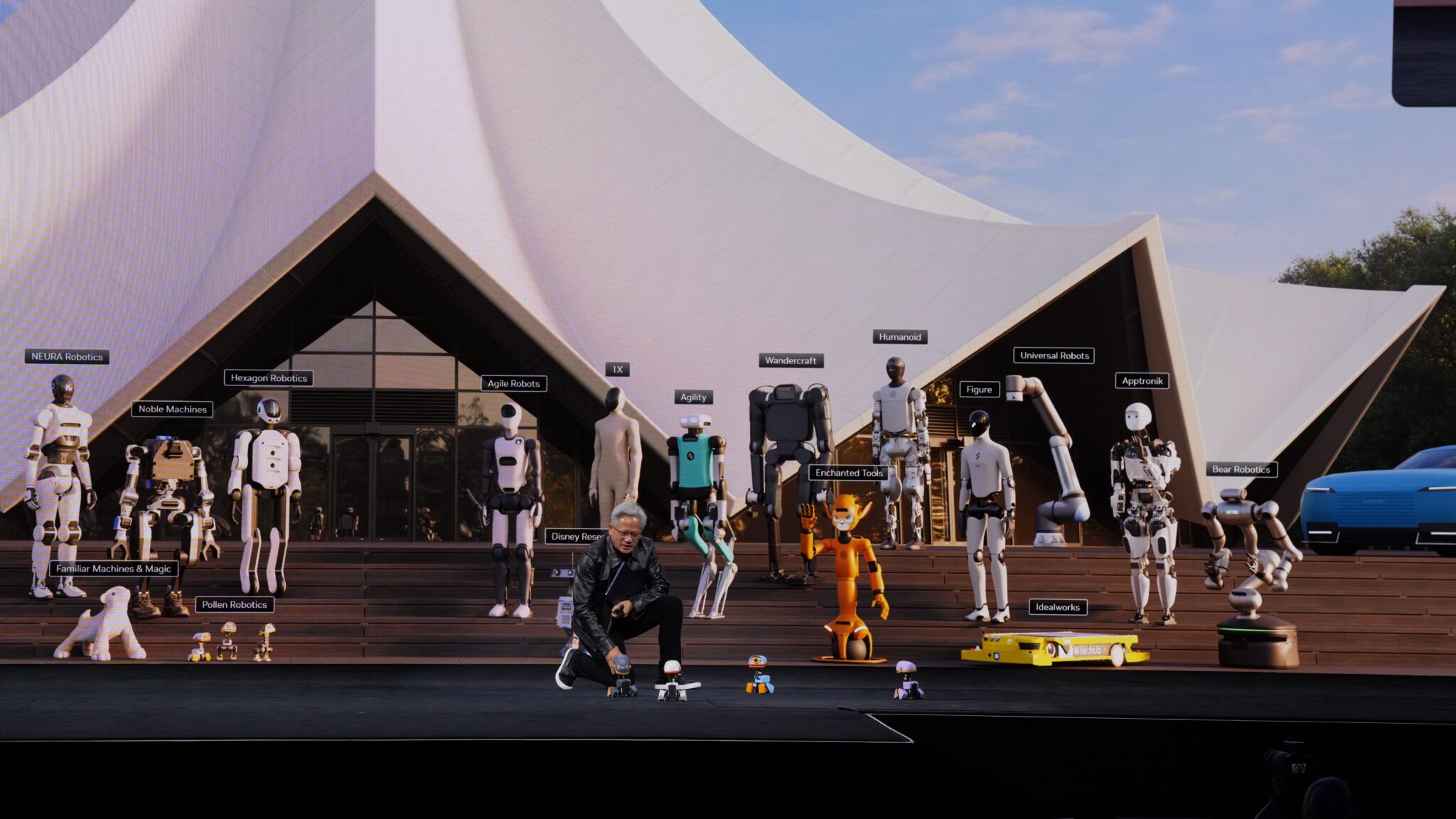
A flock of four Microducks joined Huang onstage, sitting down, standing up and even taking a nap on cue. He explained that they were created on RTX Spark, trained in the cloud and learned their skills in simulation.
“You were created on RTX Spark … [we] trained you in the cloud on a whole bunch of NVIDIA supercomputers, and you learned your skills right here on RTX Spark and the digital twin,” Huang told them.
The Full Lineup
With the Microducks gathered around him, Huang recapped the keynote: Europe is building its AI economy, AI factories are evolving to run agents and physical AI is the next frontier.
“So that’s it,” Huang said. “Everybody can build agents. Every company in Europe will become an AI company … and we’re going to have a thriving AI economy here in Europe.”
To close, Huang had one more surprise: a Eurovision-style musical send-off that turned the keynote’s themes into a comic recap.
The lyrics raced from OpenShell’s guardrails — “No credentials. Access dismissed” and “Sentry on BlueField never clocks off” — to physical AI, where robot training was likened to “college for robots without student loans.”
The punchline: “You can’t spell fungible without fun.” A saxophone solo led into a rousing “We are Europa” chorus.
“Let’s work together to build Europe’s AI economy and put AI to work,” Huang said, closing out his talk. “Have a great GTC.”
Explore NVIDIA GTC Berlin blogs and press releases in the online press kit.

 Studio