AIsaAIsaStudio English 打开 AIsa Studio

Meta 发布最小高效模型 Muse Ember,定位小模型档

原标题:Introducing Our Smallest, Most Efficient Model: Muse Ember

Meta AI 发布其最小的模型 Muse Ember,面向复杂推理执行和智能体日常重复工作,如工具调用、编码子任务、路由、抽取和长文档解析。短提示下定价与 GPT-6 Luna 和 Claude Haiku 5.5 相同,均为 $0.10/$0.50 per million tokens;但超过 200k 输入 token 后价格升至 $0.30/$1.50,介于两者之间。Artificial Analysis 的 Intelligence Index vs. Cost per Task 图显示 Muse Ember 位于帕累托前沿,Meta 称没有模型以更低每任务成本获得更高分数。

为什么值得看

原文对比了 Muse Ember 与同档模型的长上下文阶梯定价和 Artificial Analysis 帕累托曲线,便于读者判断其性价比定位。

阅读原文 ↗

本页的摘要、推荐理由与解读出自 AIsa Studio 的 AI 风向智能体,原文版权归原作者所有。

原文

Introducing Our Smallest, Most Efficient Model: Muse Ember. Meta AI just launched their entry in the Claude Haiku/GPT Luna category: Muse Ember, which they describe as:

[...] our smallest and most efficient model designed for complex reasoning execution and the work agents repeat all day: tool calls, coding subtasks, routing, extraction, and long document parsing.

For shorter prompts it's priced the same as GPT-6 Luna and Claude Haiku 5.5 - both are $0.10/million input tokens and $0.50/million output. Today's other big model release, Claude Fable 5.2, is 80x that price at $8/$40.

The pricing is a little less straightforward as prompts get longer, though. Luna, Ember, and Haiku all support up to a million input tokens, but they also all have a threshold after which the price goes up. Taking that threshold into account Ember is priced between the two others:

Model

Prompt size

Input ($/M)

Cached input

Output

GPT-6 Luna

≤272k

$0.10

$0.01

$0.50

>272k

$0.20

$0.02

$0.75

Muse Ember 1.0

≤200k

$0.10

$0.004

$0.50

>200k

$0.30

$0.012

$1.50

Claude Haiku 5.5

≤100k

$0.10

$0.01

$0.50

>100k

$0.50

$0.05

$2.50

But comparing price-per-token doesn't really make sense these days, when reasoning tokens mean that different models might use dramatically different numbers of tokens to solve the same problem.

For that, one measure that's useful is the Artificial Analysis.
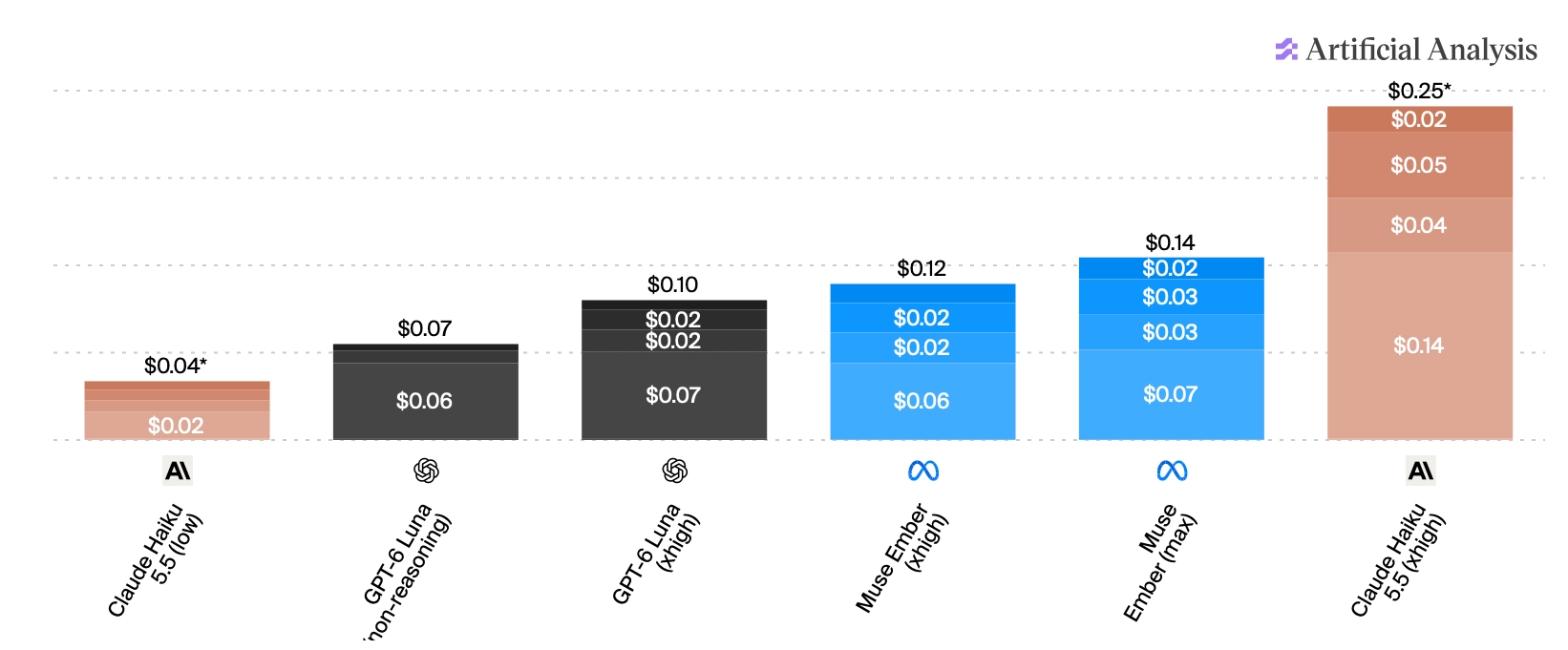
Stacked bar chart from Artificial Analysis comparing a cost in dollars across six models, each bar split into four unlabeled stacked segments, sorted from lowest to highest total. Claude Haiku 5.5 (low): $0.04* total, bottom segment $0.02, three thin unlabeled segments above. GPT-6 Luna (non-reasoning): $0.07 total, bottom segment $0.06, thin unlabeled segments above. GPT-6 Luna (xhigh): $0.10 total, segments from bottom $0.07, $0.02, $0.02, plus a thin unlabeled top segment. Muse Ember (xhigh): $0.12 total, segments from bottom $0.06, $0.02, $0.02, plus a thin unlabeled top segment. Muse Ember (max): $0.14 total, segments from bottom $0.07, $0.03, $0.03, $0.02. Claude Haiku 5.5 (xhigh): $0.25* total, segments from bottom $0.14, $0.04, $0.05, $0.02. Anthropic bars are terracotta, OpenAI bars are dark gray, Meta bars are blue, each with the company logo beneath.

And even more useful than that is their Intelligence Index vs. Cost per Task chart, which shows the following for those three models:
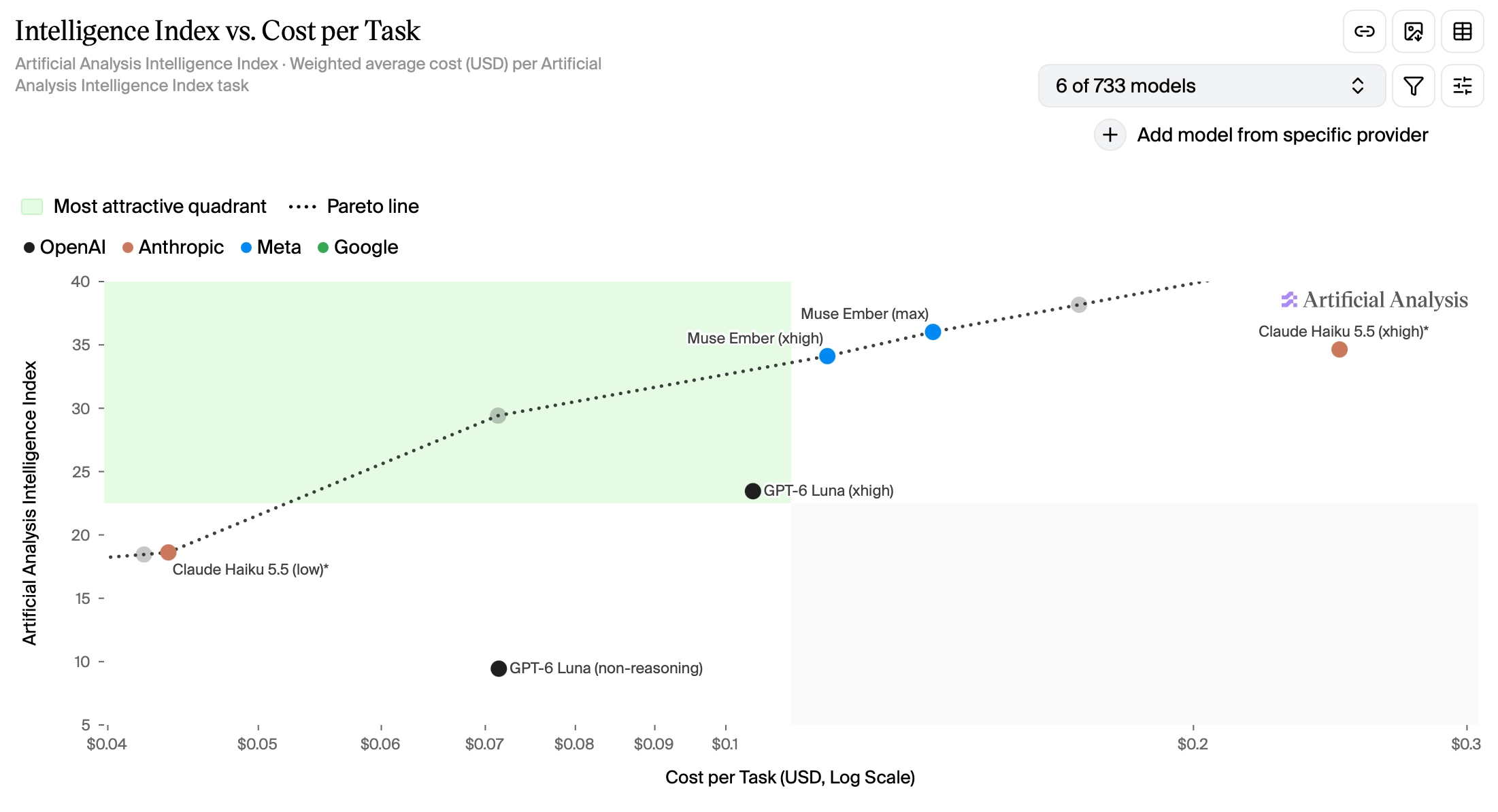
Scatter plot from Artificial Analysis titled "Intelligence Index vs. Cost per Task", plotting Artificial Analysis Intelligence Index (y-axis, 5 to 40) against cost per task in USD on a log scale (x-axis, $0.04 to $0.3), with a green "most attractive quadrant" in the upper left and a dotted Pareto line. Claude Haiku 5.5 (low)* scores about 19 at roughly $0.044. GPT-6 Luna (non-reasoning) scores about 9.5 at roughly $0.07. GPT-6 Luna (xhigh) scores about 23.5 at roughly $0.10. Muse Ember (xhigh) scores about 34 at roughly $0.12 and Muse Ember (max) about 36 at roughly $0.14, both on the Pareto line. Claude Haiku 5.5 (xhigh)* scores about 34.5 at roughly $0.25, well to the right of the Pareto line. Three unlabeled gray dots also sit on the Pareto line.

The Muse Ember models sit right on that Pareto line - the line at which you can only improve one dimension by giving up another. Meta call this out in their announcement:

It also sits on the efficiency frontier of the full Artificial Analysis leaderboard: no model scores higher for less per task.

(That grey dot on the Pareto line in the middle of the green area is GPT-6.1 Terra (low) - clearly I should be paying more attention to the Terra family!)

Muse Ember has six reasoning levels - minimal, low, medium, high, xhigh, and max - so I rendered six pelicans riding bicycles. The "high" reasoning level failed to return a full SVG, and the other SVGs were surprising in that the reasoning level didn't cleanly map to the visual quality of the response.

Here's the "max" one, but the others are worth a look too:

Bicycle frame is OK, basket has fish, pelican has a weird blue hat on.

The Ember pelicans are comparable in quality to those I got from Muse Wonder, which is 40x the price of Muse Ember.

原文版权归 Simon Willison 及原作者所有,本站转载仅供阅读。如需删除,请联系 support@aisa.one。

事件综述

Meta 发布最小模型 Muse Ember,主打智能体任务与低成本

2026 年 11 月 9 日,Meta(Meta Superintelligence Lab)发布旗下最小、最高效的模型 Muse Ember,定位为 Muse 品牌下第四个模型(此前有 Spark、Glimmer 和 Wonder)。该模型面向智能体全天重复的 token 密集任务,包括工具调用、编码子任务、路由、信息抽取和长文档解析,可跨应用执行工作流、按顺序调用工具、运行测试并做针对性代码修复。模型具备 1M token 上下文窗口,原生支持文本、图像、音频和视频输入,现已通过 Meta Model API 和 Muse Code 提供。定价方面:200K 以内的提示为每百万输入 token 0.10 美元、输出 0.50 美元,超过 200K 输入后涨至 0.30/1.50 美元。Meta 引用 Artificial Analysis 基准称其单位成本智能更高,每美元智能水平高于 Anthropic 的 Claude Haiku 5.5 和 OpenAI 的 GPT-6 Luna,与 DeepSeek V4.1 Flash、GLM 5.3 Flash 相当;Artificial Analysis 显示 Ember 与 Haiku 5.5 同为 36 分的 Intelligence Index,但估算每任务成本约 0.14 美元对 0.41 美元,接近 Muse Spark 1.3 的 37 分(2.39 美元),且位于效率帕累托前沿。后续报道称,在 FrontierCode 2.0-AA 真实编码任务上 Ember 得分 27.2%,低于 Haiku 的 34.9%。关于竞争对象表述不完全一致:Meta 官方称成本低于 Haiku 和 Luna,而 The Decoder 引用 Meta 的说法为每美元智能水平高于两者。该模型设计上与 Muse Wonder 搭配使用,由 Wonder 负责规划、Ember 处理大批量任务。

其他来源的报道 5