
Today we are releasing DaisyRose-27B, RadixArk’s first model, built on Qwen3.8-27B and trained with reinforcement learning using Miles. We trained it on long-horizon agent tasks with sessions up to 1M tokens, with just 1,200 curated tasks in 18 days on 144 H200 GPUs. DaisyRose-27B improves Terminal-Bench 4.1 pass@1 from 5.6% to 12.0%. Beyond Terminal-Bench 4.1, it also delivers gains on a variety of other reasoning, instruction following, and coding benchmarks.
The checkpoints are available under Apache 2.0:
The model retains Qwen3.8-27B’s architecture, tokenizer, chat template, image understanding, and 256K-token context window. The longer training sessions use harness summarization to span multiple trajectories. See the model card for model properties and inference settings.
Run DaisyRose-27B
We recommend serving DaisyRose-27B with SGLang and DSpark speculative decoding. The SGLang cookbook provides launch configurations for different GPUs and checkpoint formats.
After starting the server with the served model name DaisyRose-27B on port 30000, you can send a request using the OpenAI Python client:
from openai import OpenAI

client = OpenAI(
    base_url="http://localhost:30000/v1",
    api_key="none",
)

response = client.chat.completions.create(
    model="DaisyRose-27B",
    messages=[
        {
            "role": "user",
            "content": "How many positive divisors does 360 have?",
        }
    ],
    temperature=1.0,
    top_p=0.95,
    extra_body={"top_k": 20, "min_p": 0.0},
)

print(response.choices[0].message.reasoning_content)
print(response.choices[0].message.content)
The model thinks before answering by default. Its reasoning is returned in reasoning_content, and its final answer in content. These settings follow the model card’s quickstart.
Benchmark results
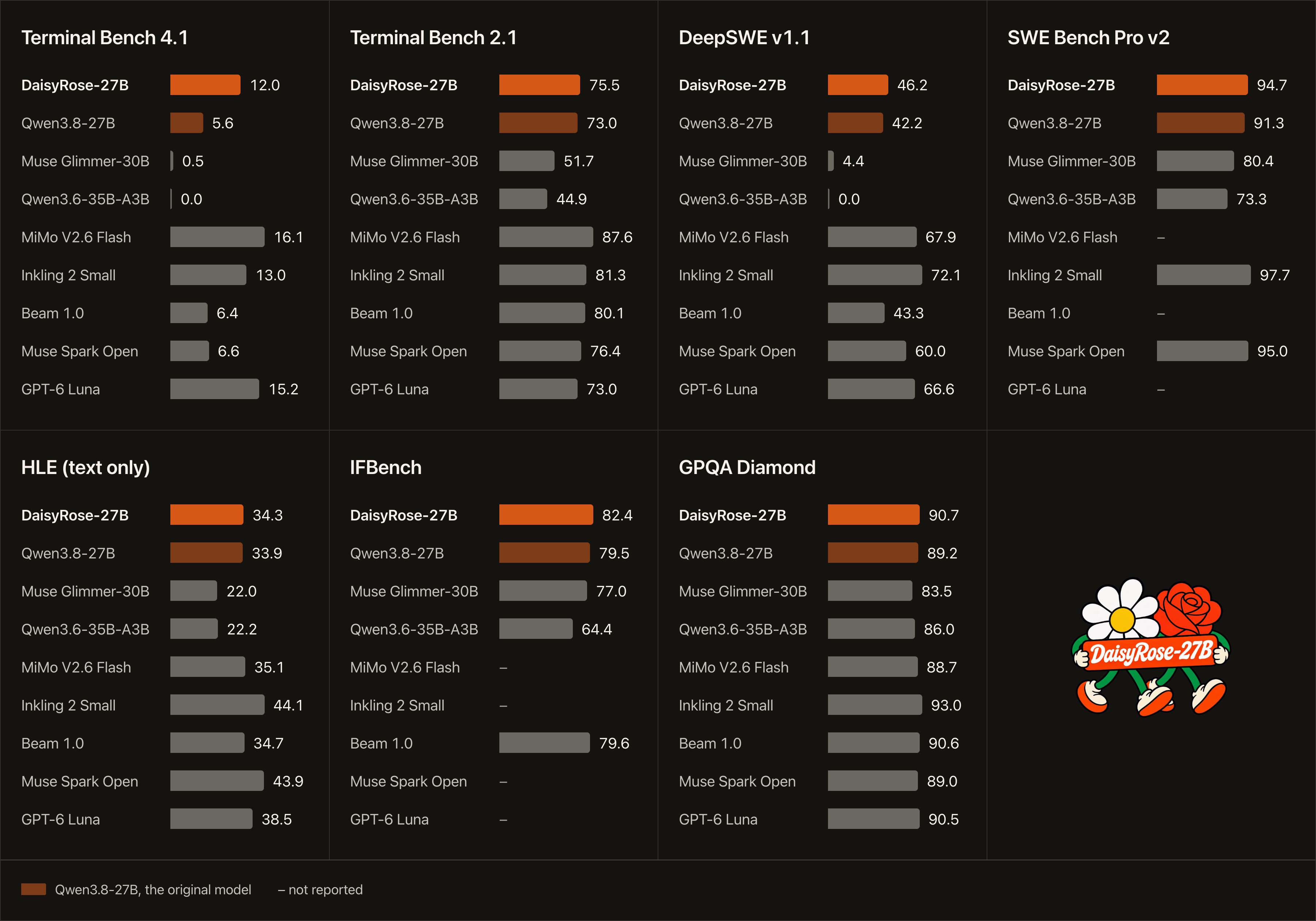
Benchmark
Qwen3.8-27B
DaisyRose-27B
Terminal Bench 4.1
5.6
12.0
Terminal Bench 2.1
73.0
75.5
DeepSWE v1.1
42.2
46.2
SWE Bench Pro v2
91.3
94.7
HLE (text-only)
33.9
34.3
IFBench
79.5
82.4
GPQA Diamond
89.2
90.7
DaisyRose-27B scores higher than the original Qwen3.8-27B model on every benchmark above. The largest gain is on Terminal Bench 4.1, where pass@1 rises from 5.6% to 12.0%.
Scores use the higher of the BF16 and FP8 runs for each benchmark; the two differ by less than one point wherever both were evaluated. The model card includes comparison sources and evaluation settings.
Three parts of the training setup made this release possible: carefully designed tasks, an efficient training backend, and reliable sandboxes.
High-quality training data
We built the tasks in partnership with Eigent AI, starting from its large pool of tasks in machine learning, software engineering, science, and other fields. Together we built thousands of candidates. About 1,200 made it into the final training set.
We selected tasks using three criteria:
- Each task targets a mistake the original model makes. We ran Qwen3.8-27B on every task and redesigned each one around the mistakes we wanted the model to stop making. We then adjusted the difficulty until the solve rate fell within a useful learning range.
- Each task requires several interdependent steps. The agent has to reason, plan, and execute across a long job. Each attempt gets up to 1.5 hours in a sandbox, with more than 100 tool calls and more than 256K output tokens.
- Tasks must reward actually solving the problem. We reviewed every task alongside the model’s attempts. Tasks that could be passed without solving the intended problem, or that contained a design flaw, were fixed or removed.
Efficient training backend
RadixArk trained DaisyRose-27B with Miles, our open-source reinforcement learning framework for large-scale model post-training, in fully asynchronous mode: the agent keeps working while the model learns, and neither waits for the other. While 128 H200s run the inference on agent tasks, 16 more run the trainer and learn from the trajectories. After every step, the updated model goes out to the 128 GPUs that run the agent. The learning runs on our internal training backend, which is built for agent training: each step learns from a handful of very long sessions, some as long as 1M tokens, folded into multiple trajectories via harness summarization.
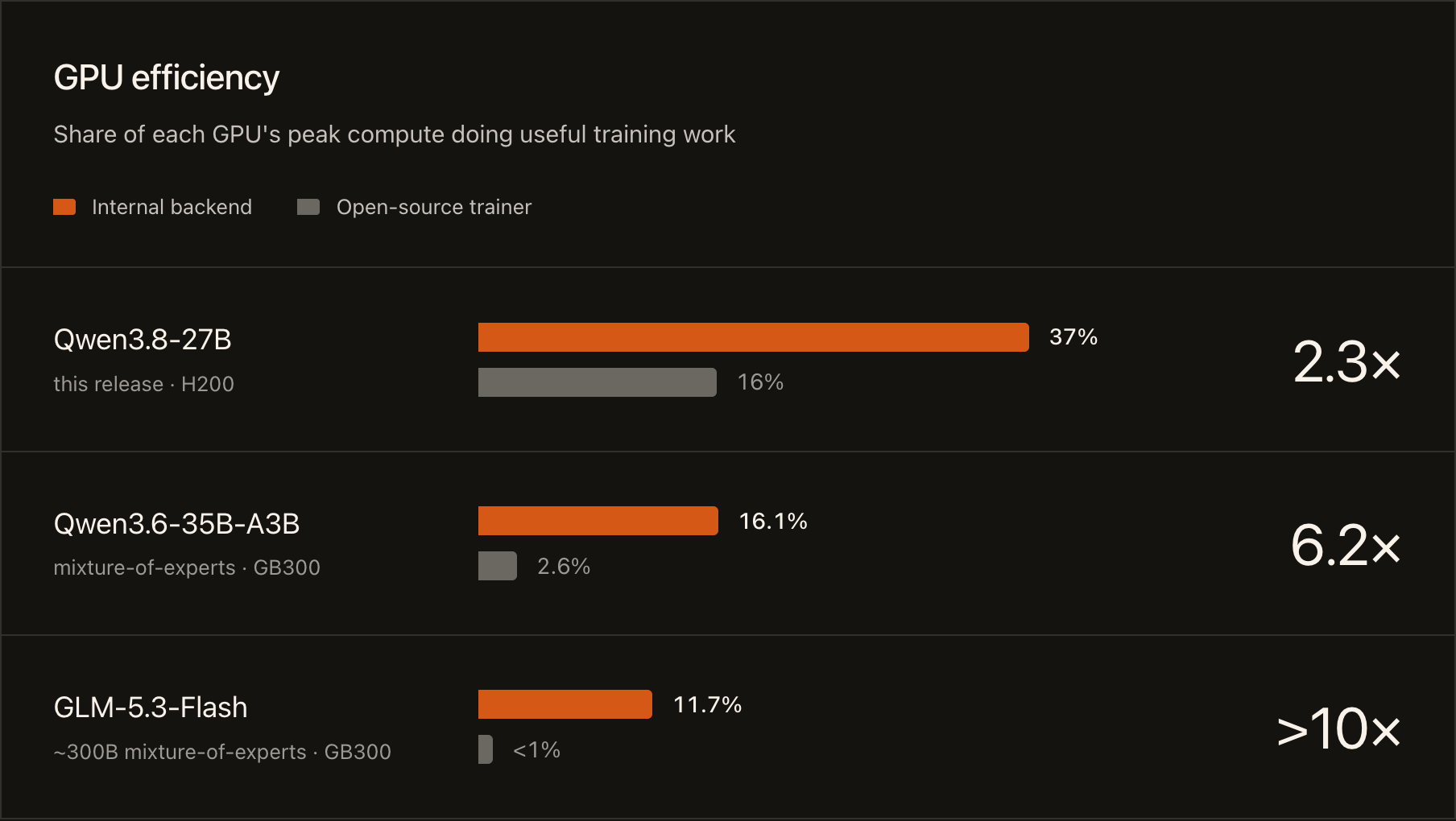
57% lower training cost. On this release, 37% of each GPU’s peak compute went into useful training work (model FLOPs utilization, or MFU) on our backend. The open-source trainer, built on Megatron, reached 16% on comparable runs. So the same training needs 57% less GPU time. The gain is even larger on mixture-of-experts models: 6.2× on Qwen3.6-35B-A3B, and more than 10× on the roughly 300B-parameter GLM-5.3-Flash.
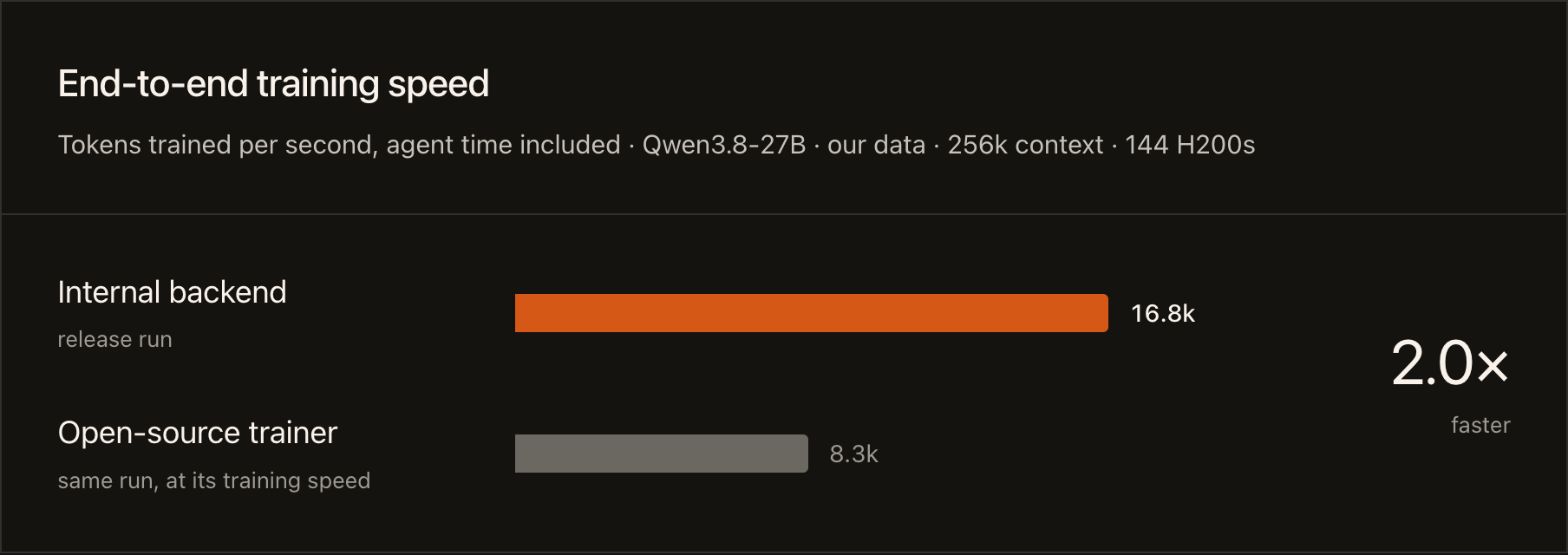
2× faster end to end. Counting the time the agent spends on its tasks, the release run trained on about 16,800 tokens per second across its 144 GPUs. The open-source trainer reached about 8,300 on the same GPUs.
Stable over weeks. The release run trained for weeks on 144 H200s, 63,000 GPU-hours in total. From the first step to the last, its speed and efficiency held steady.
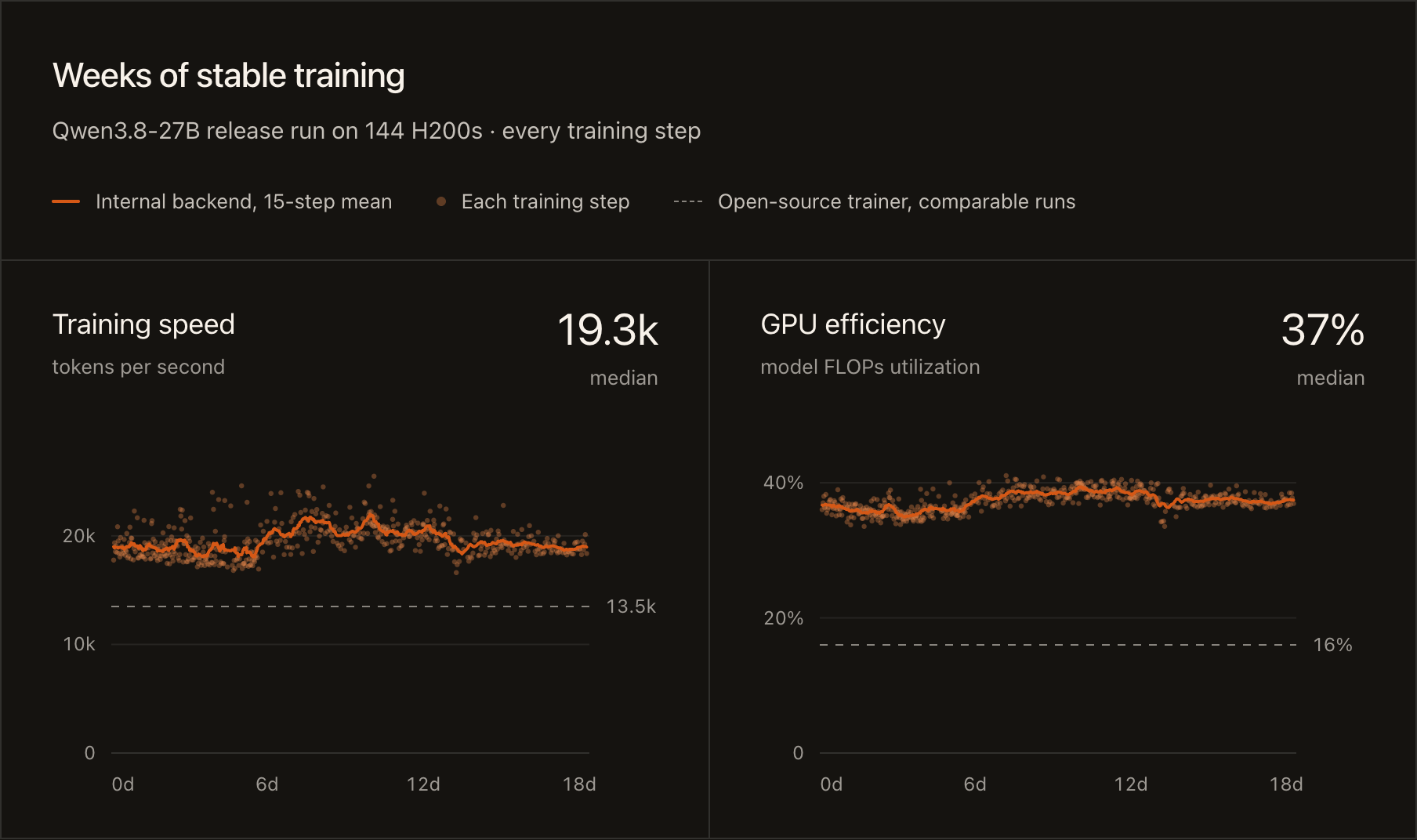
Every training step of the DaisyRose-27B release run on 144 H200s, plotted against total training time. Dashed lines: the open-source trainer on comparable runs.
Robust sandbox service
Every training attempt runs in a sandbox: a fresh copy of the task’s environment where the agent runs commands, edits files, and is then graded.
Our service is built on the open-source AgentENV project, to which we also contribute fixes. Between mid-September and mid-November, it ran about 944,000 sandboxes for this project, with up to 1,566 running concurrently.
The service grew from one machine to as many as 12. We shipped ten upgrades to it, nearly all while training was running. Across all nine weeks, 99% of sandbox creations succeeded; since late October, that figure has exceeded 99.95%.

Cloud infrastructure costs for the project’s sandboxes were about 80% lower than running the same sandboxes with popular cloud sandbox providers. One way we keep costs down is to let each sandbox’s memory allocation grow and shrink with its actual usage, allowing more sandboxes to share each machine.
Try the model or train your own
Download DaisyRose-27B, follow the SGLang serving guide, or use Miles to train your own agents.
We’d like to hear how DaisyRose-27B performs on your tasks, including where it falls short. Share your setup and results in the model’s Community tab.
We thank Eigent AI for working closely with us on training data, and the Qwen team for creating Qwen3.8-27B. We also thank the Miles and SGLang communities, along with other open-source projects including slime, AgentENV, and Harbor.
Adapted from the original RadixArk article.
原文版权归 Hugging Face Blog 及原作者所有,本站转载仅供阅读。如需删除,请联系 support@aisa.one。


