Latent Space's AINews reports that Jensen Huang resigned as NVIDIA CEO, president and board member after 33 years, with CFO Colette Kress serving as interim CEO and a board investigation underway. The issue also covers Gemini 4 Hydrogen's broad launch, Thinking Machines' Apache 2.0 open-weight Inkling 2 Small, Will Depue's claim that Chinese models were initialized on Blackwell GPUs, Anthropic's IPO filing, and various agent and developer tooling updates.
Based on 50+ top posts and 5,500+ practitioner comments from r/AI_Agents over the past year, the author identifies 7 production failure modes: silent failures where agents grade their own homework, multi-agent swarms inflating costs 15x through lossy LLM handoff summaries, paying agent tokens for deterministic steps, a plain git-backed Markdown wiki (98.5%) beating 8 commercial vector/graph memory systems on a 2,176-task benchmark, harness token bloat of 18,000-30,000 tokens per turn (variable-reference tool outputs cut tokens 82% and latency 93%), rubber-stamp human-in-the-loop review, and the "lethal trifecta" where untrusted text, private data, and write/payment tools in one agent make prompt injection unsolvable. The takeaway: winning teams build deterministic state machines with narr…
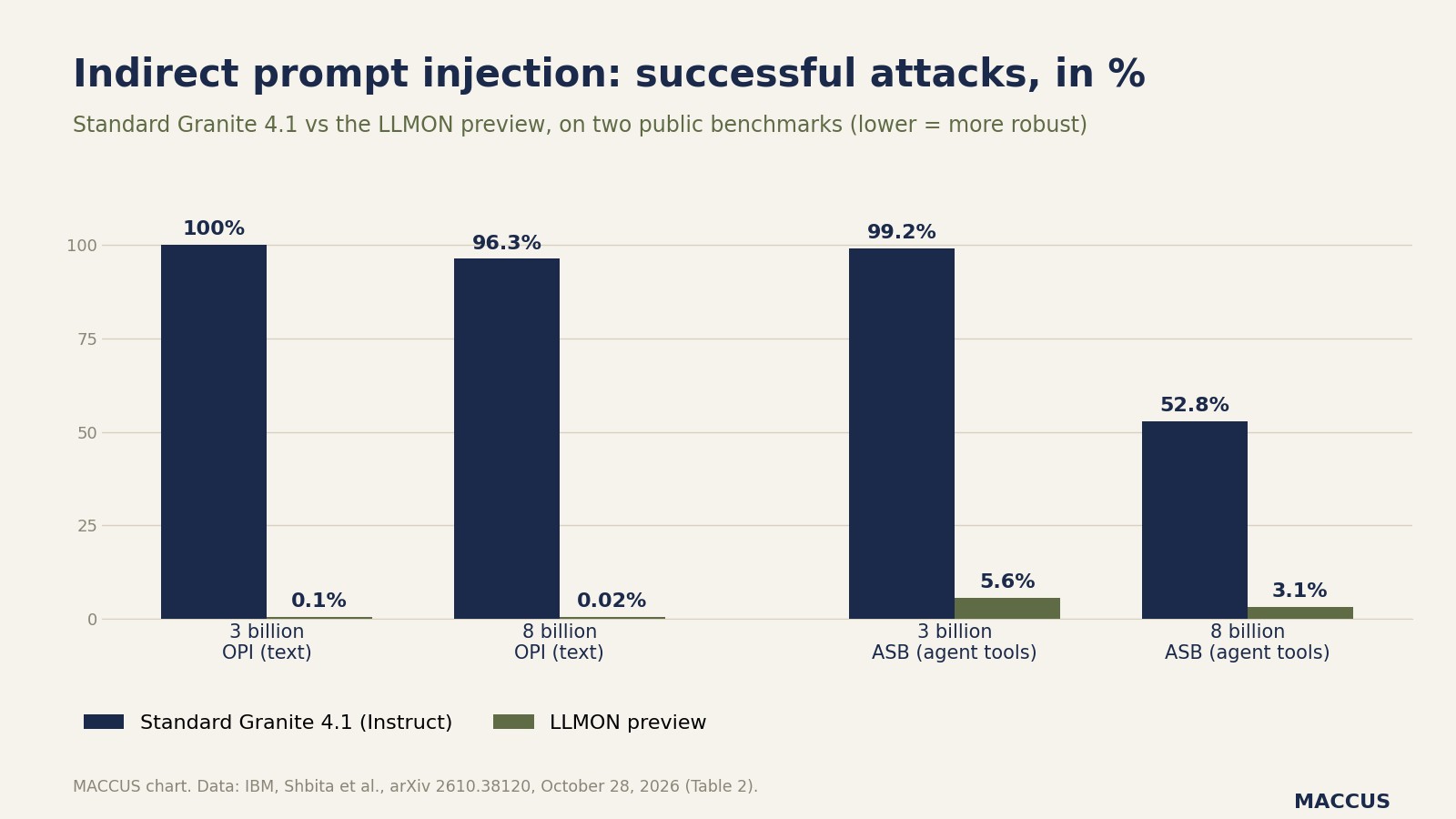
On November 12, 2026, IBM's Granite team released two open preview models, granite-4.1-3b-llmon-preview and granite-4.1-8b-llmon-preview, trained to ignore indirect prompt injections using the LLMON labeling system that separates instructions from read content. Both are Apache 2.0 licensed and downloadable from Hugging Face; on the OPI benchmark, attack success rates drop from 100% to 0.1% for the 3B model and from 96.3% to 0.02% for the 8B. IBM still limits the previews to exploration and evaluation, noting direct and multi-turn attacks remain far harder to block, and general capabilities barely changed (3B kept 66.7, 8B dropped from 74.2 to 72.8).

Adventists AI released Sophon-Realtime v1, an Apache-2.0 open full-duplex voice model family with a shared 32B brain and three builds: Tag, Flash and E2E. It reports VoiceBench 82.8 and paralinguistic understanding 48.6, ranked #1 among open full-duplex models; E2E reaches ~0.25s first audio, Flash supports 40 users per 80GB GPU, and all builds run on vLLM-Omni with a single command.
The author updated tandem.cpp, a llama.cpp patch set that keeps hot experts on the GPU while the CPU handles the rest, adding AMD ROCm (HIP) support. DeepSeek-V4.1-Flash IQ2_XS on a 16 GB card with 64 GB RAM decodes at 14.2 tok/s vs 7.4 with stock llama.cpp; on a 16 GB card with 32 GB RAM it hits 34.3 tok/s vs 14.9. DeepSeek-V4.1, gpt-oss-120b, GLM-4.5-Air and Qwen3.6 gain 1.4–2.1x over plain llama.cpp. On an RX 7900 XTX it performs level with stock Strata 0.2.9; Vulkan is not yet supported.

OpenAI is reassigning its robotics researchers to other teams, with core researchers moving under Chief Research Officer Mark Chen and applied robotics and hardware joining Greg Brockman's Applied organization. The company reportedly believes general-purpose models like GPT-6 Astra can control robots directly: in an Nvidia simulation an Astra-powered agent hit a 74.8 percent success rate versus 51 percent for the best specialized models, and on StationeryBench Astra completed 7 of 100 tasks versus none for Ai2's MolmoAct2. OpenAI disbanded robotics in 2020, rebuilt the team in 2024, and reportedly targets a first public robot demo in 2027.

Former Anthropic and OpenAI researcher Jacob Coxon says a slide from Anthropic's IPO roadshow was a key reason he quit after about four months. He reads the log-scale chart of the pre-training compute multiplier for code as showing accelerating, superexponential algorithmic progress, arguing Anthropic could already retrain Mythos with a fraction of the original compute, that algorithmic improvements are on the verge of being automated, and that frontier development should pause next year. Anthropic notes the data points are internal estimates for illustration only.

DeepSeek open-sourced chat-demo, a TypeScript static chat app powered by the DeepSeek API that runs entirely from the browser with no backend; it gained about 1,595 stars within two days of creation. It supports streaming replies, deep thinking, smart search, link reading, attachments, voice input, Markdown/KaTeX/Mermaid rendering, and bilingual, dark/light themes; data stays in localStorage and IndexedDB, and the online demo is available at https://deepseek-ai.github.io/chat-demo/.

 Studio

