AIsaAIsaStudio 中文 Open AIsa Studio
AI Windvane · Daily picks

Nov 22 AI Daily

8 AI stories picked from 5 sources, ranked by importance, plus 5 trending.

November 22, 2026 Sun8 picks5 trending
Top story

AINews: Riemann Hypothesis claimed proved twice independently

Latent Space's AINews reports two mathematicians claiming independent Riemann Hypothesis proofs hours apart: Anthropic's Levent Alpöge released a Claude-assisted proof as Lean code (about 250,000 pages if written out, with the Lean bug chance put well under 1%), while Alessandro Masullo announced a 940-page purely human draft. The issue also covers Thinking Machines' open-weight 26.4B looped MoE Inkling 2 Mini, Gemini 4 Neon's developer reception and benchmarks, Tencent's Hy4, and Anthropic's $81.3B IPO.

Why it matters

This AINews roundup pairs the two claimed Riemann Hypothesis proofs with releases like Inkling 2 Mini and Gemini 4 Neon, plus a look at weak-to-strong alignment in AI math collaboration.

Trending 5

Stories several sources covered in the last 48 hours.

Highlights 3

Can Anthropic afford to put safety first as a public company?

Nilay Patel interviews The Verge senior AI reporter Hayden Field on Anthropic's Nasdaq IPO, priced at $83 a share and climbing to $111. The discussion covers Anthropic's unusual governance structure, including the Long-Term Benefit Trust and the Founder LLC share holding 50.1% of voting power, the company's roughly $900 billion in coming compute bills, the safety-versus-profit tension, and why OpenAI appears content to have Anthropic go public first.

Why it matters

The interview unpacks the tension between Anthropic's founder control and its safety commitments after going public, and how compute bills constrain the company.

Hours after Anthropic claims a Claude proof of the Riemann hypothesis, Stanford releases an all-human competing draft

Anthropic mathematician Levent Alpöge announced a Claude-assisted proof of the Generalized Riemann Hypothesis, backed by Lean verification that would span over 250,000 printed pages. Hours later, Stanford's Ravi Vakil released an independent all-human draft proof by Alessandro Masullo, vetted for months by Brian Conrad, though several problems in it were soon reported with AI assistance.

Why it matters

The article lays out how each proof was produced and verified, letting readers compare the evidence behind the AI and human drafts.

Anthropic releases system card for Claude Fable 5 and Claude Mythos 5

Anthropic released the system card for Claude Fable 5 and Claude Mythos 5, covering core evaluations of Mythos 5 without deployment-time safeguards. Claude Fable 5 scored a 29.8% strict pass rate on GDP.pdf, above Claude Opus 4.8 (22.5%), GPT-5.5 (24.9%), and Gemini 3.1 Pro (16.7%). Evaluations also included 181 public-set questions from a FutureHouse-developed benchmark, averaged over five runs with adaptive thinking and max effort, with and without Python tools.

Why it matters

The system card provides GDP.pdf scores and comparisons with other frontier models, letting readers gauge performance on real-world documents and research tasks.

More stories 4

Anthropic's MCP paper on code mode: 98.7% token savings, packed into one Claude Code prompt

The author distills Anthropic's MCP paper on code mode, where tool context drops from 150,000 tokens to 2,000 (98.7% savings) because the agent writes code to call tools instead of calling them directly. The six parts cover tools as .ts files, load on demand, filtering in code, loops in code, privacy by default, and saving working code to ./skills. The author packed all six parts into one prompt for Claude Code.

Why it matters

The post breaks down the six parts of Anthropic's code mode approach and offers a ready-made prompt for Claude Code, letting readers apply the pattern to their own agent workflows.

MIT paper on vibe coding shows output surged while releases and user engagement lagged

The author discusses an MIT study tracking new apps on the App Store, Play Store and Chrome Web Store after coding agents arrived: developers using autonomous agents wrote 25.5x more code with commits up 240%, but releases rose only 30%; after adopting Claude Code, developers wrote 7x more lines and deleted 12.2x more, and 30-day repo abandonment rose from 60% to 69%. New app launches roughly doubled since early 2025 while user engagement didn't move, leading the author to argue that writing code was never the real bottleneck.

Why it matters

The post juxtaposes surging output with flat releases and user engagement, offering a useful lens for judging the real returns of vibe coding.

Colgate paper shows LLM roleplay can predict purchase intent with SSR method

A Colgate-published paper shows that having LLMs roleplay customers with demographic profiles, then converting their written thoughts into scores via semantic similarity rating (SSR), can predict purchase intent. Tested against 57 real personal care surveys and 9,300 human responses, the synthetic consumers reached 90% of human test-retest reliability and mirrored how age and income groups react to price changes.

Why it matters

The post breaks down how the SSR method works and its validation against 57 real surveys, offering readers a concrete look at simulating consumers with LLMs.

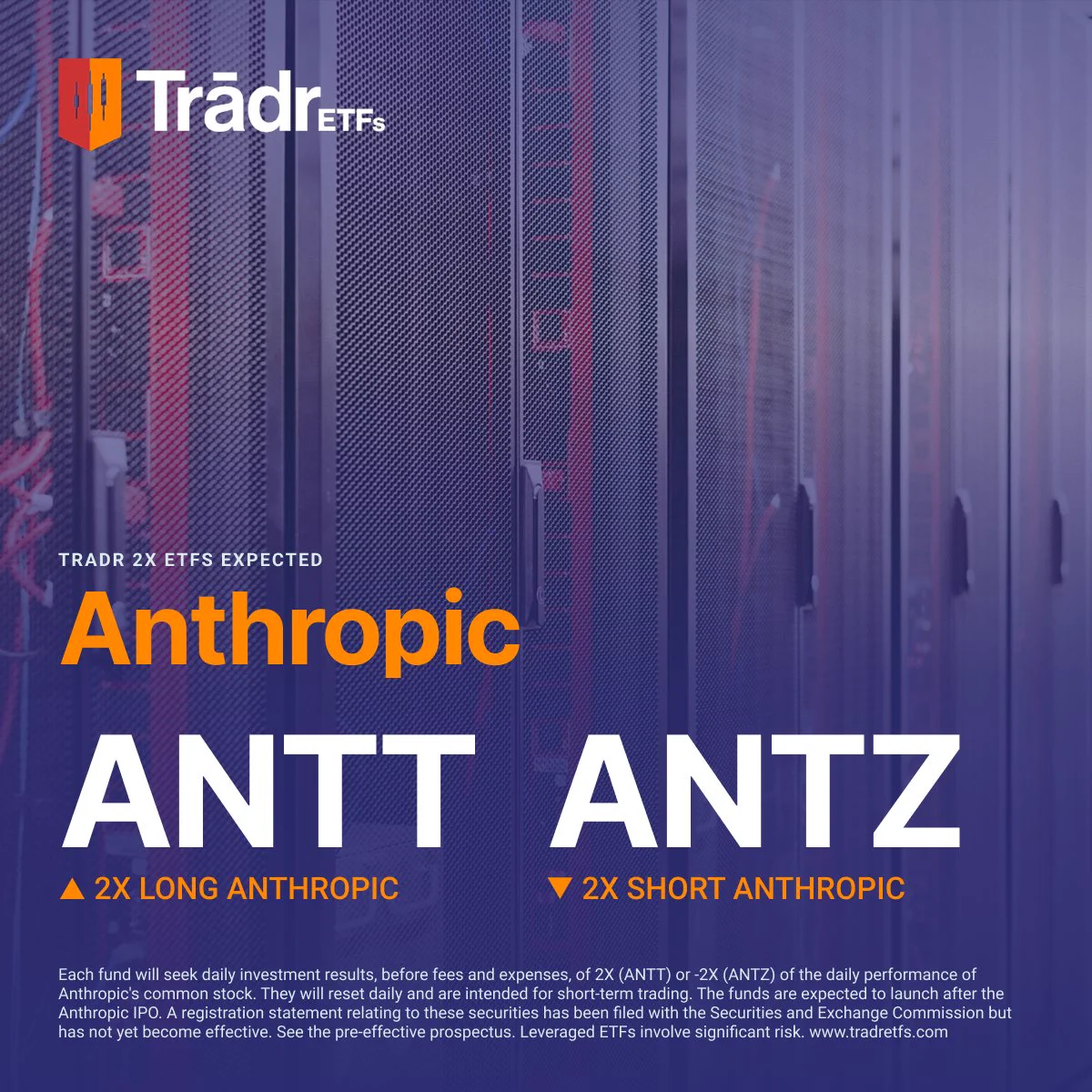
2X leveraged and inverse ETFs (ANTT/ANTZ) for newly public Anthropic expected to debut Nov 23

Following Anthropic's $ANT public listing, Tradr ETFs is rolling out two related ETFs: 2X Long ANTT for upside and 2X Short ANTZ for downside, with an expected first trading day of Monday, November 23, 2026. The post also notes leveraged ETFs involve significant risk.

Why it matters

The post names the ticker codes and first trading day of 2X leveraged and inverse ETFs tied to Anthropic's listing, useful for readers tracking available trading vehicles.

Worth watching 8

US tech stocks suffer worst weekly loss since the pandemic as AI doubts pile up

US tech stocks had their worst week since the Covid-19 crisis: the Nasdaq 100 fell 5.6 percent on Friday and 10.4 percent for the week, leaving it 20 percent below its October peak and in bear market territory. The selloff was driven by doubts over multibillion-dollar AI buildouts, the Nvidia scandal, questionable China deals, and political headwinds after the Democrats' midterm win; Nvidia plunged 14 percent on reports of an SEC accounting review, the US semiconductor index dropped 10.7 percent, and Anthropic fell 9.1 percent a day after its market debut.
OpenAI bans using its AI to help train rivals, with data sorting also covered

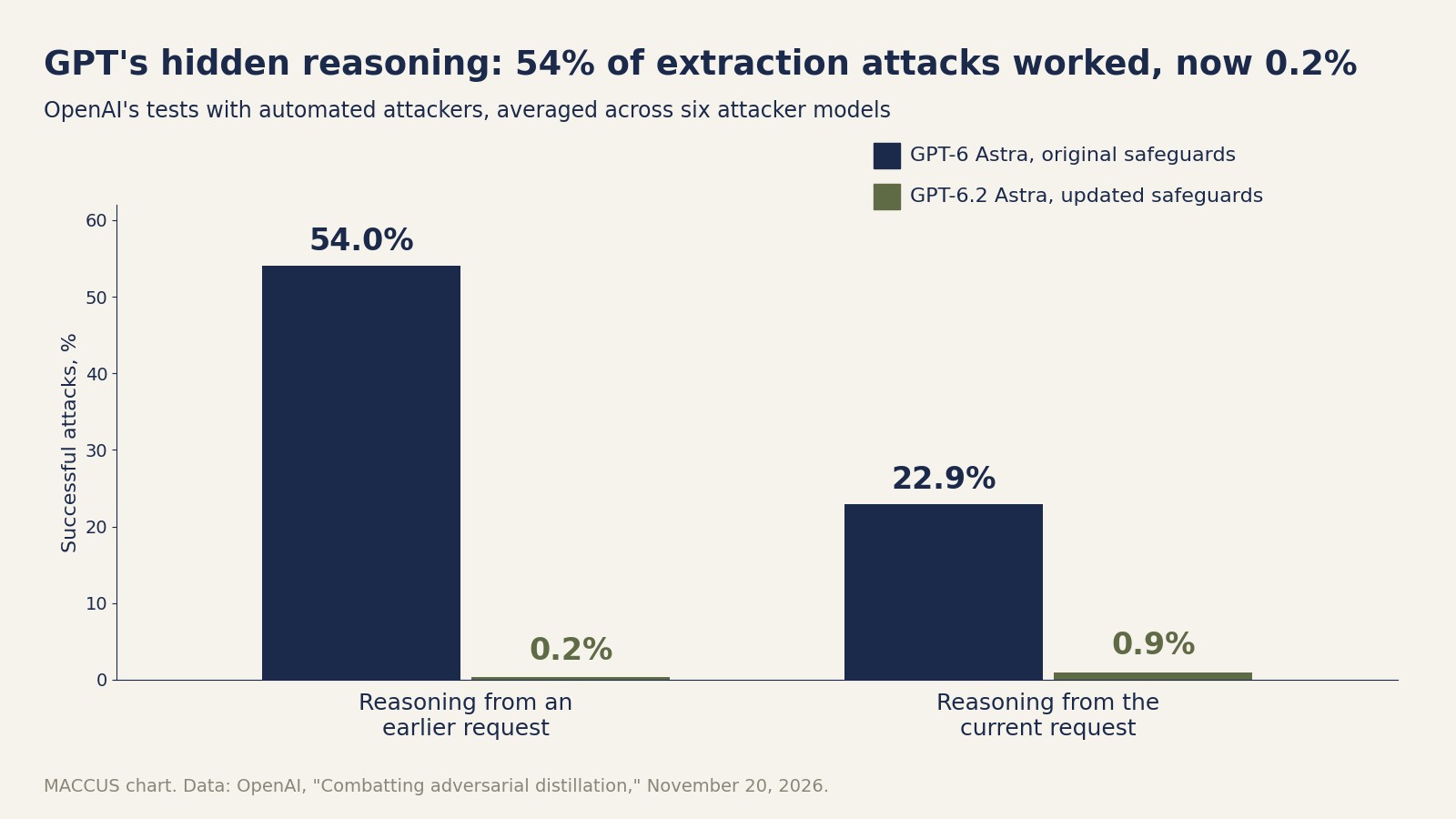
OpenAI's updated usage policies, effective November 20, 2026, add a detailed section banning the use of its models or outputs to generate, prepare, select, or supply training data for models intended to replace OpenAI's, covering data preparation, scoring, sorting, and even work done for third parties; platforms like routers and AI gateways now need OpenAI's prior approval to offer direct access. The same day, OpenAI published a post on adversarial distillation, reporting internal test results where reasoning-extraction attacks succeeded 54% of the time against GPT-6 Astra with original safeguards versus 0.2% against GPT-6.2 Astra, and claiming weekly actions against thousands to tens of thousands of accounts tied to distillation campaigns, partly attributed to people associated with Moon…

Silicon Valley's AI doomsday obsession turns parts of tech industry toward cult-like devotion

A New Yorker report by Sam Krss details Maple, a Vermont Buddhist monastery founded by Soryu Forall that seeks to become the AI industry's official church, promising salvation from AI apocalypse. Former members say the monastery records residents' conversations and breathing to train an AI modeled on Forall's mind, while leadership denies most claims. The report connects such groups' appeal to doomsday fears among AI workers, citing Jacob Coxon's 2026 Anthropic exit and a 2024 AI Impacts survey where respondents put the chance of AI causing human extinction at 18 percent on average.

Agent market research: a 20-post validation rule and how keyword matching inflated the counts

A solo web/video business owner describes a strict validation rule requiring agents to find 20+ posts from the last 30 days by different people across at least 2 places, with saved links and at least 5 showing money, before an idea is pitched. In a first run, a recount of 55 posts showed keyword matching had inflated a "50 daily video editor requests" figure to a real 37, while website-demand counts rose from 5 to about 10 once agents read non-flagged posts.

Six-month update on an AI-agent journalism company: 8-day publishing halt, €9 per article, and a Bing indexing fix

A retired trader running an AI-agent journalism company with six agents on Paperclip (mostly Haiku 4.5) shares a six-month update: a forgotten self-written rule halted publishing for 8 days, a 401 error was reported as 'done', and EU AI Act figures had to be sourced out after AI-generated blogs appeared. Costs run about €46/month (€9 per article) plus a €100 Claude subscription and ~1 hour of his time per article, with a 93% cache hit rate. Revenue is zero, but after running Bing's site scan, indexed articles rose from 2 of 52 to 39 of 54 and traffic more than doubled last month.