28th October 2026 - Link Blog
GitHub Octoverse 2026. I'm at GitHub Universe today (GitHub gave me a free ticket through their "GitHub Stars" program). EVP Jay Parikh just announced this year's Octoverse report, and highlighted these numbers in particular:
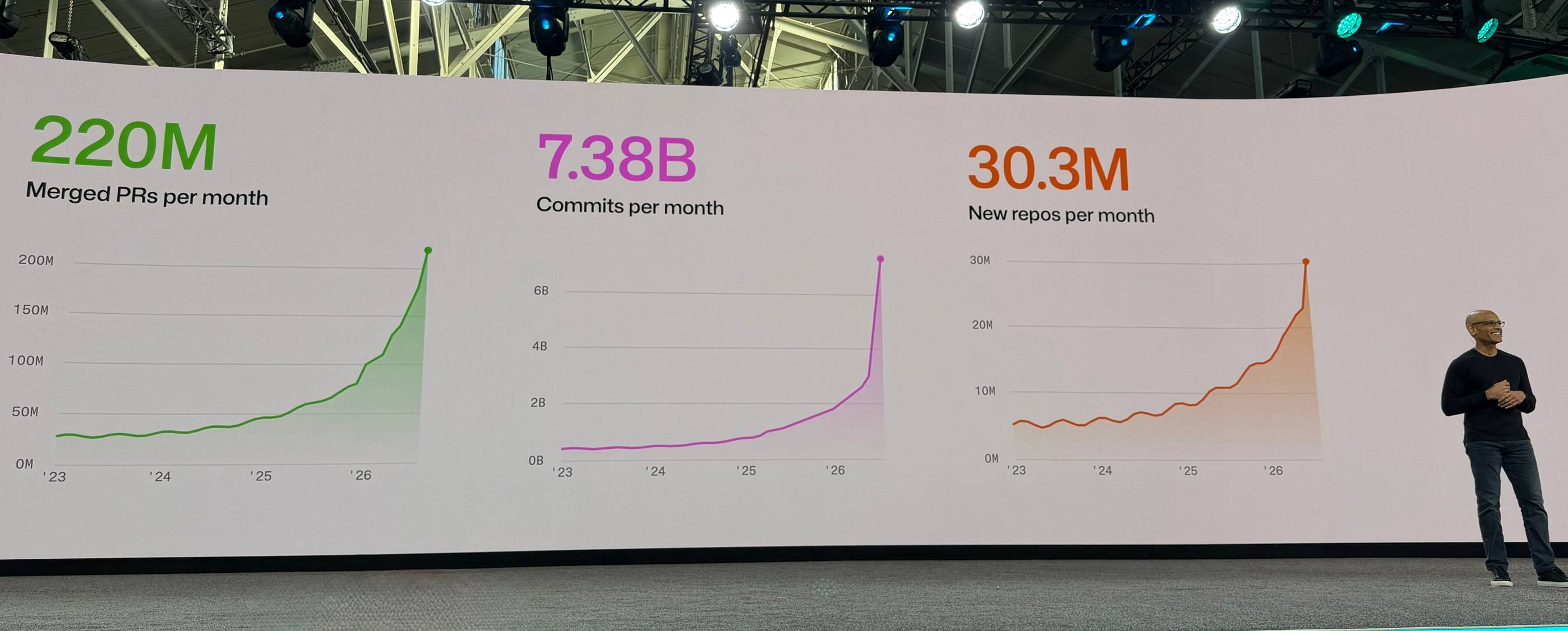
This is a pretty stark representation of the impact of agentic engineering on GitHub. In 2026, merged pull requests tripled in less than a year to 220 million per month. Commits more than tripled to 7.38 billion per month, with most of that increase in the second half of this year. New repository rate doubled this year, to 30.3 million per month.
The report includes new numbers by industry, and breaks out numbers for repositories that involve "interoperability or reverse engineering". The methodology section includes notes about how they did this:
Top countries by pushes to public repositories, adjusted by profile location. Pushes from each country were summed across the Octoverse year. To adjust for biases caused by VPN usage, LLM classification was used to extract the ISO 3166-1 alpha-2 code from the profiles of GitHub users who contributed pushes during this period [...]
Industry. Public repositories created 2022 to 2026 were sorted into NAICS sectors by a fine-tuned multilingual embedding model using name, description, topics, and README, from random samples per year. [...]
Interoperability. Counts public repositories created each year whose name, description, topics, or README mention interoperability or reverse engineering, or related terms, such as clean room implementation, drop-in replacement, or protocol re-implementation.
原文版权归 Simon Willison 及原作者所有,本站转载仅供阅读。如需删除,请联系 support@aisa.one。

 Studio